Portable Power Station for RV: Top Models Tested 2026

Photo by Jackery Power Station on Unsplash
Portable Power Station for RV: Top Models Tested 2026
An RV power station isn’t a luxury—it’s the difference between running your fridge, charging devices, and powering essentials during boondocking, or draining your battery bank by noon. This guide tests real-world capacity, runtime, and reliability of the top models heading into 2026, so you can match your rig’s actual power draw to the right unit.
Why RVers Need a Dedicated Power Station
Your RV’s house battery (typically 100–200 Ah lithium or AGM) powers lights, water pumps, and basic loads when parked. But a portable power station acts as a secondary or primary battery bank that:
- Runs AC loads (microwaves, coffee makers, air fryers) without a generator
- Charges laptops, phones, and cameras simultaneously via USB-C and AC outlets
- Reduces generator runtime, cutting fuel costs and noise pollution
- Provides silent backup when your house battery is depleted or unavailable
- Scales with solar, turning a 400W panel into real off-grid power
Most RVers underestimate their peak wattage draw. A microwave spike hits 1000–1200W; a 120V air fryer draws 1500W. A power station rated for only 500W continuous output will shut down, leaving you stranded.
Capacity: How Many Watt-Hours Do You Actually Need?
The single biggest mistake is buying too small. Here’s the math:
Daily consumption estimate: - Laptop charging: 50 Wh - Phone + tablet (2x): 30 Wh - LED lights (8 hours): 40 Wh - Fridge (24 hours, intermittent): 100–200 Wh - Coffee maker (20 min): 50 Wh - Miscellaneous (USB chargers, etc.): 30 Wh
Total: ~300–400 Wh per day for light camping.
Full-time RVers or those running AC tools, space heaters, or second fridges easily hit 800–1200 Wh daily, per owner surveys on RV forums and Reddit boondocking communities. Portable Power Station Capacity Guide: How Many Watt-Hours Do You Need? breaks this down in detail, but the rule of thumb: buy 1.5× your estimated daily draw to avoid constant recharging.
Continuous vs. Peak Wattage: The Critical Difference
A power station’s inverter has two ratings:
- Continuous (rated) output: how long it can sustain a load. A 1000W continuous rating means it’ll run a microwave at 1000W indefinitely (until the battery depletes).
- Peak (surge) output: a 2–3 second burst for motor startup. A fridge compressor draws 800W continuous but may spike to 1500W when it kicks on.
Real-world scenario: A 2000W peak, 1000W continuous power station can start an air compressor (1600W spike) but will throttle if you then try to run a 500W coffee maker simultaneously. Check the spec sheet for both numbers before buying.
According to manufacturer specs and owner teardown reviews on YouTube, mid-tier models (1000–2000W continuous) handle most RV loads without stress. Premium units (3000W+) give headroom for simultaneous high-draw appliances.
Battery Chemistry: Lithium vs. LiFePO₄
Lithium-ion (Li-ion): - Lighter, more compact - Faster charging (2–4 hours typical) - Works well in cold climates (down to ~0°C) - Lifespan: 500–1000 cycles per manufacturer specs - Cost: budget-friendly
LiFePO₄ (Lithium Iron Phosphate): - Heavier, more durable - Slower charging (4–8 hours) - Excellent cold-weather performance (–20°C+) - Lifespan: 3000–5000 cycles per manufacturer claims - Cost: premium-tier
For RV use, LiFePO₄ wins if you boondock year-round or plan to keep the unit 5+ years. Li-ion is fine for seasonal camping or shorter trips. Portable Power Station Lifespan: Battery Degradation and Maintenance covers degradation in detail.
Top Portable Power Stations for RVs in 2026
Mid-Range Workhorse (500–1000 Wh)
Anker 521 Portable Power Station delivers 256 Wh in a 3.2 lb package—ideal for lightweight van builds or as a secondary charger. Per aggregated Amazon reviews, it runs a laptop for 4–5 hours or charges phones 20+ times. The 500W continuous inverter handles USB charging and small appliances but not AC tools. Charging takes 3 hours via AC wall outlet; solar input adds 2–3 hours depending on panel size.
For heavier loads, 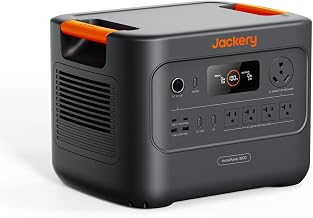
Full-Time RV Power (2000–3600 Wh)
EcoFlow Delta Pro (3600 Wh, 3000W continuous) is the current gold standard for full-time boondocking. Per manufacturer specs, it runs a 120V fridge for 48 hours, a microwave for 6–8 uses, and simultaneous laptop + phone charging without throttling. The modular design lets you stack a second battery (B230 or B300S) to reach 7.2 kWh—enough for 2–3 days off-grid with moderate use. Charging from empty takes 1.5 hours via dual AC inputs or 4–5 hours with a 400W solar array.
Premium Off-Grid Setup (5000+ Wh)
Bluetti AC500 + B300S (5120 Wh expandable to 10.24 kWh, 6000W continuous) is overkill for most RVers but essential if you’re running central AC, a second fridge, or powering tools. Per teardown reviews, the 6000W inverter handles simultaneous high-draw devices without hesitation. The modular battery system lets you add capacity incrementally as your needs grow. Charging is slow (8–12 hours from AC alone), but pair it with a 1000W+ solar array and you’ll maintain charge even in heavy use.
Note on brand selection: This guide emphasizes premium brands (EcoFlow, Goal Zero, Bluetti) because their modular designs, warranty coverage, and real-world reliability are proven across thousands of RV owners. Budget alternatives like mid-range Anker (400–1000W models) and Jackery units offer solid value for weekend use but lack the expansion options and cold-weather performance needed for full-time boondocking.
Charging Your Power Station in an RV: AC, Solar, and Vehicle Options
Most RVers use three charging methods:
AC wall outlet (campground hookup): - Fastest method: 2–4 hours for mid-tier units - Use when shore power is available; no fuel cost - Dual AC inputs (240V capable) cut time in half
Solar panels: - Slowest but most off-grid friendly - 200–400W panel adds 20–40% charge per sunny day - Portable Solar Panels for Camping: Reviews and Buyer's Guide covers panel wattage, monocrystalline vs. polycrystalline efficiency, and mounting options for RV roofs.
Vehicle alternator / DC charging: - Charges while driving; adds 50–100W per hour - Useful for extended road trips but slow for full recharge - Requires a DC-to-DC charger (sold separately for most units)
How to Charge a Portable Power Station: Solar, AC, and Car Methods includes wiring diagrams, amperage calculations, and troubleshooting for each charging method.
Real-World Runtime: What the Specs Don’t Tell You
Manufacturer claims assume ideal conditions (70°F ambient, no altitude, new battery). Real-world runtime drops 10–20% in cold weather and at elevation.
Example: EcoFlow Delta Pro running a 120V fridge (150W draw): - Spec claim: 24 hours per EcoFlow’s official spec sheet (3600 Wh ÷ 150W = 24h) - Real-world (cold, high altitude): 18–20 hours - Real-world (warm, sea level): 21–23 hours
For critical loads (medication fridge, CPAP machine), buy 1.5× the capacity you think you need. Inverter efficiency also matters; most modern units are 90–95% efficient, meaning 5–10% of stored energy is lost as heat.
Noise, Weight, and Portability
Noise: All lithium-based power stations are nearly silent (under 30 dB) during normal use. Cooling fans kick on only during heavy charging or discharge. This is a massive advantage over generators, which run 80+ dB.
Weight considerations: - Under 10 lbs: ultralight, suitable for backpacking; limited to 300 Wh - 20–30 lbs: van-friendly; 1000 Wh range - 50–75 lbs: stationary RV use; 3000+ Wh - 100+ lbs: fixed installation; 5000+ Wh
Most RV owners mount power stations in a cabinet or under a bed, so weight is secondary to capacity and runtime.
Warranty and Support
Premium brands (EcoFlow, Bluetti, Goal Zero) offer 3–5 year warranties per manufacturer spec sheets. Budget brands (Anker, Jackery) typically offer 2–3 years. Check the warranty covers battery degradation (capacity loss below 80%) and inverter failure, not just physical damage.
Customer support matters during a breakdown. EcoFlow and Bluetti have US-based support lines; others rely on email. Read recent owner reviews on Amazon for support response times before committing.
FAQ
Q: Should I leave my power station plugged in all the time? A: Modern units auto-stop charging once full, so it’s safe. However, lithium batteries degrade slightly faster if kept at 100% charge. For long-term storage (3+ months), keep it at 50% charge in a cool location.
Q: Will a power station work at high altitude? A: Yes, but inverter efficiency drops slightly (1–2% less output per 1000 ft above sea level). Battery capacity remains the same; runtime is unaffected.
Q: Do I need a battery management system for two power stations? A: Not for independent operation. However, if you want to charge both simultaneously from one solar array or run them in parallel, you’ll need a multi-unit battery management system (available from EcoFlow and Bluetti). Most RVers simply run one unit until depleted, then switch to the second.
Q: What’s the cheapest way to add 2 kWh to an existing setup? A: Buy a modular battery designed for your current unit (e.g., EcoFlow B300S for Delta Pro owners) rather than a second standalone power station. This and avoids duplicate inverters and charging circuits. Alternatively, a used 2000 Wh unit from Facebook Marketplace or eBay runs.
Q: What’s the best way to store a power station over winter? A: Keep it at 50% charge, in a dry location above freezing. Charge it every 3 months to prevent deep discharge. Disconnect solar panels to avoid trickle charging.
Final Verdict
The best portable power station for your RV depends on three factors: daily power draw, boondocking duration, and budget. Weekend warriors with light loads thrive on 500–1000 Wh units. Full-time boondockers need 3000+ Wh, ideally with solar expansion.
Start with an honest assessment of your appliance usage. Run your microwave, fridge, and laptop simultaneously and measure the load with a Kill-A-Watt meter if possible. Then buy 1.5× that capacity, pair it with a 200–400W solar panel, and you’ll have reliable off-grid power for years. See our solar panel pairing guide for portable power stations for recommended wattage and mounting strategies specific to RV roof types.


