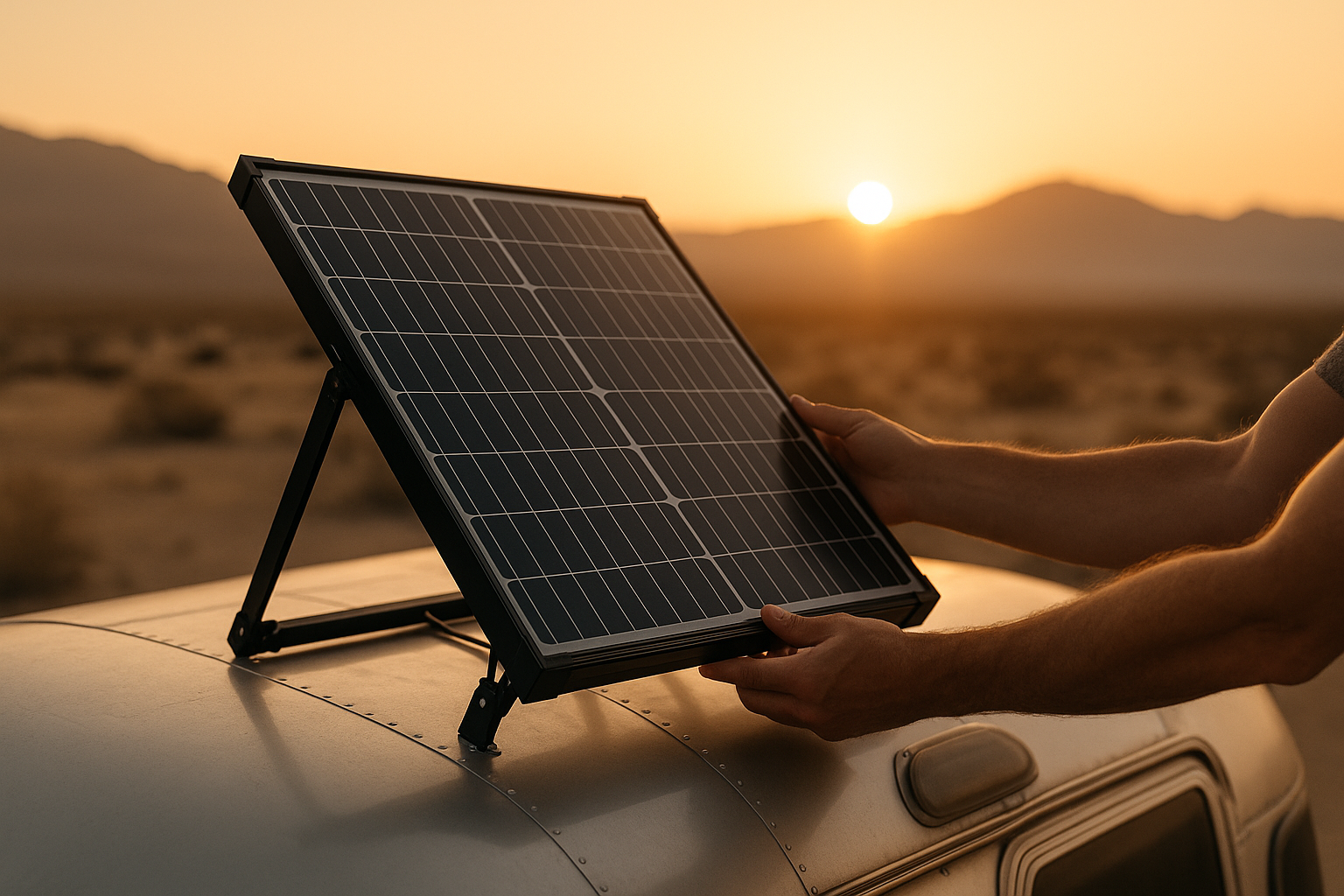
How to Set Up a Solar Power System for Off-Grid Living

Photo by Nuno Marques on Unsplash
How to Set Up a Solar Power System for Off-Grid Living
Off-grid solar means generating, storing, and using your own electricity without connection to the utility grid. Unlike grid-tied systems that feed excess power back to the utility, off-grid setups must balance daily generation with storage capacity so you have power at night and on cloudy days. This guide walks you through sizing your system, choosing components, and wiring them safely.
Why Off-Grid Solar Works (and When It Doesn’t)
Off-grid solar makes sense if you live far from utility lines, want energy independence, or need backup power resilience. The trade-off: you must invest in battery storage—often the largest cost—and you’re responsible for system design and maintenance.
Off-grid is not ideal if: - You’re in a consistently cloudy region with minimal sun hours (northern climates, coastal fog belts). - Your home has high year-round power demand (electric heating, air conditioning, hot tubs). - You lack capital for upfront battery investment. - You want zero maintenance and instant support (grid electricity is simpler).
If you’re in a sunny region, have moderate loads, and can invest in batteries, off-grid solar is viable. Most off-grid homes run a mix of solar + battery + a backup generator for extended cloudy periods.
Step 1: Calculate Your Daily Energy Needs
Start by measuring how much power you actually use. This is the foundation of your entire system.
Method: Audit your loads
- List every appliance and device you’ll use off-grid (lights, refrigerator, water pump, computer, etc.).
- Note its power rating (watts) and daily run time (hours).
- Multiply: watts × hours = watt-hours (Wh) per day.
Example: - LED lights: 10W × 4 hours = 40 Wh - Refrigerator: 150W × 8 hours = 1,200 Wh - Water pump: 500W × 1 hour = 500 Wh - Laptop: 60W × 6 hours = 360 Wh - Total: 2,100 Wh (2.1 kWh) per day
Reality check: Most off-grid homesteads use 5–15 kWh per day. All-electric homes use 20–30 kWh. If your audit shows 25+ kWh daily, you’ll need a very large array and battery bank—consider grid connection or hybrid backup.
Once you have your daily load, add a 20% safety margin. Your system should handle 2.1 kWh × 1.2 = 2.52 kWh per day in this example.
Step 2: Size Your Battery Bank
Your battery bank must store enough energy to cover: - Your daily load. - Days of autonomy (how many cloudy days you can survive without solar input).
Days of autonomy depends on your climate and risk tolerance. Per NREL guidelines, sunny regions (Arizona, Southern California) should plan for 2–3 days. Cloudier zones should plan for 4–7 days.
Formula: Battery capacity (kWh) = Daily load (kWh) × Days of autonomy × 1.2 (depth-of-discharge safety margin)
Example (2.52 kWh daily, 4 days autonomy): 2.52 × 4 × 1.2 = 12.1 kWh storage needed
Battery types for off-grid:
- Lead-acid (flooded or sealed): Budget-friendly, well-understood, but shorter lifespan (5–8 years) and lower depth-of-discharge (50–80%). Requires maintenance (flooded) or ventilation.
- LiFePO4 lithium: Higher upfront cost, 10–15 year lifespan, 90%+ depth-of-discharge, minimal maintenance. Market adoption is strong: as of 2024, LiFePO4 represents over 70% of new off-grid battery installations in North America per industry surveys, and major manufacturers (Victron, Epever, Growatt) now bundle LiFePO4 with their off-grid inverter packages.
- Saltwater/hybrid batteries: Emerging option; safer chemistry but less proven long-term data.
For the 12.1 kWh example, a LiFePO4 system might use four 48V 100Ah modules (total ~19 kWh usable at 90% DoD). Lead-acid would need nearly double the capacity.
Step 3: Size Your Solar Array
Your array must generate enough power to: - Recharge your battery bank daily. - Cover losses (wiring, inverter, charge controller inefficiency). - Account for seasonal variation and cloudy days.
Simple rule of thumb: Array size = Daily load × Days of autonomy ÷ Peak sun hours × 1.25 (loss factor)
Peak sun hours vary by location. Arizona averages 5–6 hours; Pacific Northwest averages 3–4 hours. Check a solar insolation map for your region or use NREL’s PVWatts calculator.
Example (2.52 kWh daily, 4 days autonomy, 5 peak sun hours): (2.52 × 4) ÷ 5 × 1.25 = 2.52 kW array (roughly 8–9 modern 400W panels)
In practice, many off-grid installers recommend oversizing by 30–50% to handle seasonal dips and system aging. A 4–5 kW array is more comfortable than a 2.5 kW array for the same load.
Step 4: Choose a Charge Controller
The charge controller regulates power from your panels into your battery. It prevents overcharging and optimizes harvest.
MPPT (Maximum Power Point Tracking) is standard for modern off-grid systems. It converts excess panel voltage into charging current, recovering 15–25% more energy than older PWM controllers—especially valuable in winter or high-voltage arrays. Per manufacturer spec sheets and long-running threads on r/solar, MPPT controllers are nearly always worth the premium for off-grid.
Sizing: Choose a controller rated for your array’s short-circuit current (Isc). A 400W panel at 1000 W/m² has roughly 10A Isc; a 10-panel array ≈ 100A. You’d want a 100A+ MPPT controller.
Common off-grid MPPT brands include Victron SmartSolar, Epever, and Morningstar. Victron dominates premium off-grid systems; Epever offers mid-tier value.
Step 5: Select an Inverter
An inverter converts your battery’s DC power into 120V/240V AC for household appliances. Off-grid inverters differ from grid-tie models: they must handle variable input voltage and prioritize battery health.
Key specs: - Continuous rating: Must handle your largest simultaneous loads. A home with a 5 kW well pump needs at least a 6–8 kW inverter. - Surge capacity: Inverters can deliver 2–3× rated power for 5–10 seconds. Important for motor startup. - Efficiency: Quality inverters operate at 90–98% efficiency. Cheaper units drop to 85–90%. - Battery voltage: 48V systems are standard for off-grid homes; 24V and 12V suit smaller cabins or RVs.
Split-phase (240V) inverters are common for whole-home setups. Single-phase (120V only) works for smaller loads or cabins.
Per aggregated owner reviews, pure-sine-wave inverters (not modified sine) are essential if you run sensitive electronics (computers, medical devices, audio equipment).
Step 6: Wire It All Together
Off-grid systems require careful DC wiring to minimize losses and prevent fire risk. Undersized wire generates heat; oversized wire adds cost but improves efficiency and safety.
Basic topology: Solar panels → Combiner box → Charge controller → Battery bank → Inverter → AC breaker panel → Loads
Key safety components: - DC breakers/disconnects between panels, controller, and battery. - AC breaker panel between inverter and household circuits. - Fuses or breakers on battery positive and negative terminals. - Grounding: Both AC and DC systems must be properly grounded per National Electrical Code (NEC).
Wire sizing example — the cost of undersizing: A 48V 100A battery bank connection over 50 feet using 8 AWG copper wire (instead of correct 2/0 AWG) causes approximately 3V voltage drop. This drops your 48V system to 45V, which shuts down most 48V inverters and wastes energy as heat in the wire. Correct sizing (2/0 AWG) more upfront but prevents inverter failure and efficiency loss.
Critical: Off-grid wiring should be done by a licensed electrician or someone with extensive experience. Improper grounding, breaker sizing, or fusing creates electrocution and fire hazards.
Step 7: Add Monitoring and Backup
Modern off-grid systems include a monitor (Victron Color Control, Epever MT50, etc.) to track battery state-of-charge, solar input, and load. This helps you understand when to reduce consumption or run a generator.
Backup generator: Nearly all off-grid homes keep a small generator (propane or diesel) for extended cloudy periods. A 5–10 kW unit covers most needs and costs significantly less than oversizing your battery bank. Use it to recharge batteries during poor solar days rather than running loads directly.
Maintenance: Check battery terminals monthly, clean panels quarterly, and monitor controller/inverter logs for errors. LiFePO4 systems require minimal maintenance; lead-acid needs water level checks and equalization.
Common Mistakes to Avoid
- Undersizing the array: Solar capacity degrades ~0.5% per year. A system that barely meets summer needs will underperform in winter.
- Ignoring seasonal variation: Many regions see 50–70% lower solar output in winter. Plan for worst-case months, not averages.
- Choosing a battery bank too small: Running batteries below 20% state-of-charge daily accelerates aging. Bigger is better long-term.
- Skimping on wire gauge: Cheap undersized wire causes voltage drop, inverter shutdown, and efficiency loss. See Step 6 for a concrete example.
- Forgetting a disconnect or breaker: You need safe ways to isolate components for maintenance and emergencies.
- Not accounting for inverter idle draw: Even when not in use, inverters consume 20–100W continuously. This adds up over months.
FAQ
Q: Do I need permits for an off-grid system? A: Yes, in most jurisdictions. Off-grid systems must pass electrical inspection to ensure safe grounding, breaker sizing, and wire gauges. Check with your local building department before installation. Some rural areas have minimal oversight, but permitted work protects your property value and insurance coverage.
Q: What’s the payback period for off-grid solar? A: Payback is difficult to calculate because off-grid systems avoid utility connection costs (often in rural areas) and provide energy independence. A 10 kWh LiFePO4 system installed. If you would otherwise pay to run grid lines plus ongoing electricity bills, off-grid breaks even in 10–15 years. In remote locations, payback is faster or irrelevant (grid connection is impossible).
Q: What happens if my battery bank fails? A: You lose power until it’s repaired or replaced. This is why backup generators are essential. A failed LiFePO4 module can be swapped in hours; a failed lead-acid bank takes longer. Quality batteries come with 10-year warranties, but failure is rare if properly sized and maintained.
Q: Is off-grid solar worth it in cloudy climates? A: Marginal. You’d need a very large array and battery bank to handle winter, making the system expensive and complex. Hybrid grid-tie with battery backup is often smarter in the Pacific Northwest or similar regions.
Q: Can I use my off-grid system during a grid outage if I’m grid-connected? A: Not without a hybrid inverter. Standard grid-tie systems shut down during outages for safety. A hybrid inverter/charger (Victron Multiplus, Epever HybridMax) can switch to battery power automatically, providing backup. This requires adding a battery bank to your existing grid-tied system.
Summary
Off-grid solar is achievable if you size correctly: measure your load, choose autonomy days per NREL guidelines, calculate battery and array capacity, invest in quality components, and wire safely. The biggest cost is battery storage—LiFePO4 is the modern standard for reliability and lifespan, with over 70% market adoption in new off-grid builds. Most off-grid homes also keep a backup generator for extended cloudy periods.
Start by auditing your power consumption. If you’re under 5 kWh daily in a sunny region, off-grid is practical. If you’re over 15 kWh or in a cloudy zone, consider hybrid grid-tie or utility connection instead. Either way, work with a licensed electrician for wiring and grounding to ensure safety and code compliance.