Backup Power for Sump Pump During Outage: Battery & Generator Options
Backup Power for Sump Pump During Outage
A power outage during heavy rain is a homeowner’s nightmare: your sump pump stops running, water pools in your basement, and you’re facing thousands in damage before the power returns. The good news is that you don’t have to choose between hoping the grid comes back quickly and watching your foundation flood. Battery-backed and generator-powered solutions exist specifically for this scenario, and they’re more affordable and practical than you might think.
Why Your Sump Pump Needs Backup Power
A sump pump is one of the most critical loads in a basement. Unlike a refrigerator or HVAC system—which can tolerate brief interruptions—a sump pump must run continuously during a heavy rain event or your basement will flood within minutes. A typical submersible sump pump draws between 500–1,500 watts during operation, depending on the motor size and water depth. That’s not a trivial load, but it’s also not so large that backup power is impossible.
Power outages often happen during storms—exactly when your sump pump is most needed. When the grid fails, water will accumulate in your sump basin and eventually overflow into your basement, causing structural damage, mold, and ruined belongings.
The solution is straightforward: keep your sump pump powered during an outage using either a battery backup system or a portable/standby generator.
Battery Backup Systems for Sump Pumps
Battery backup is the quietest and most convenient option for homeowners who want automatic, hands-off protection. These systems are designed to kick in the moment the grid fails, with no manual setup required.
How Battery Backup Works
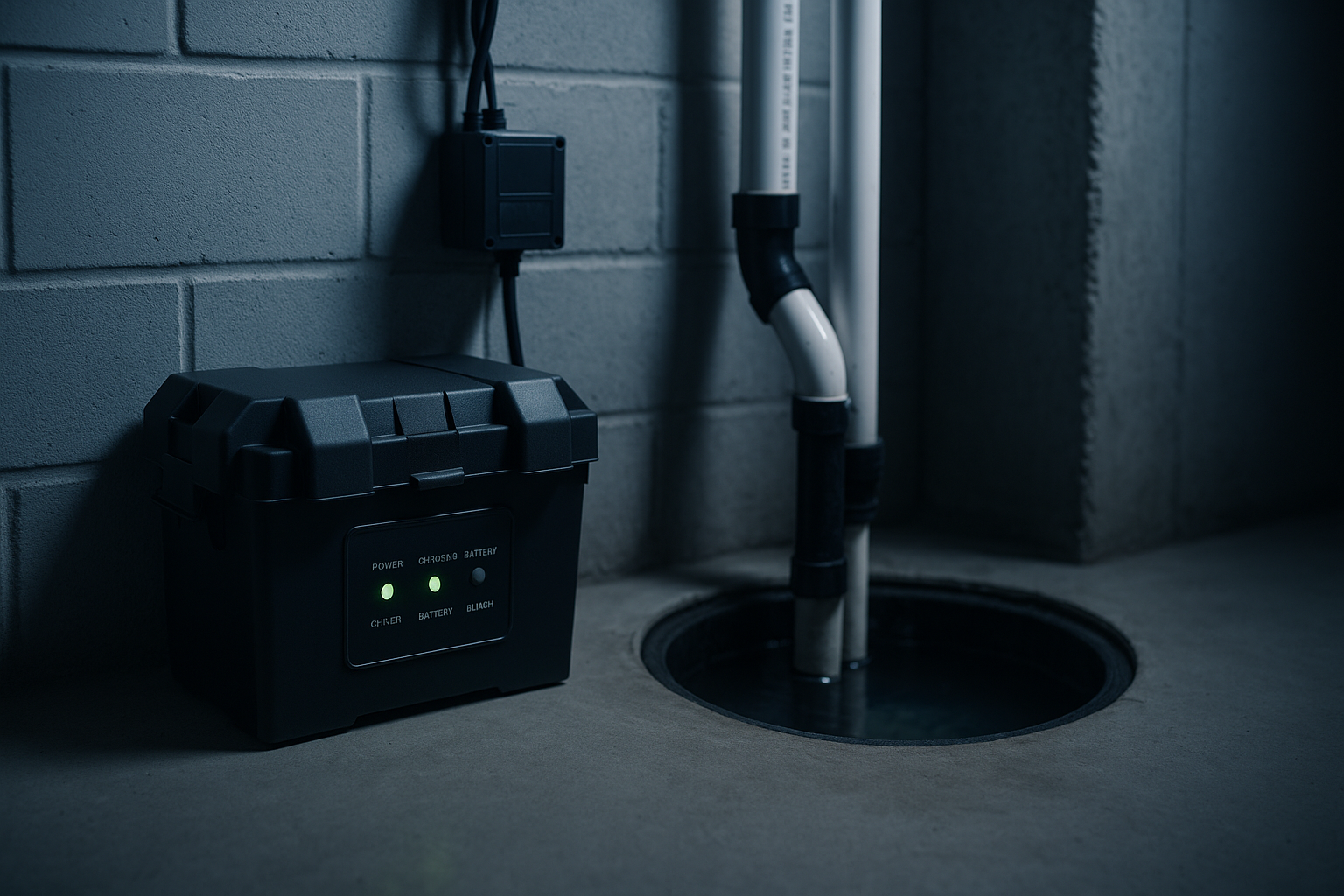
A sump pump battery backup (also called a UPS-style backup) is a dedicated unit that sits next to your sump pump basin. It has its own built-in pump or connects to your existing pump via a float switch. When power fails, the battery automatically switches on and continues pumping water out of the basin. Some systems use a separate backup pump; others use an inverter to power your primary pump directly from the battery.
The advantage is zero downtime: the moment the grid goes out, the backup system engages. There’s no need to run outside to start a generator or flip a switch. The disadvantage is runtime: most dedicated sump pump batteries last 4–8 hours of continuous pumping, depending on basin depth and water inflow rate. If the outage is longer, you’ll need to either recharge the battery (if power returns) or switch to a generator.
Battery Capacity and Runtime
A standard sump pump draws 500–1,000 watts during operation. To estimate runtime, you need to know your battery’s watt-hour (Wh) capacity and the pump’s draw.
Example calculation: - Pump draw: 800 watts - Battery capacity: 3,000 Wh (3 kWh) - Estimated runtime: 3,000 ÷ 800 = 3.75 hours - Accounting for ~15% inverter losses, expect ~3.2 hours in practice
In practice, most homeowners see 3–6 hours of continuous pumping from a mid-tier battery backup, which covers the majority of grid outages. For longer outages, you’d pair the battery with a generator as a secondary backup, or keep the battery charged via solar panels.
Dedicated Sump Pump Battery vs. Portable Power Station
There are two types of battery backup for sump pumps:
Dedicated sump pump battery backup (e.g., Zoeller, Liberty, Basement Watchdog models) is purpose-built for this task. It includes a float switch, backup pump, and battery all in one compact unit. These are typically cheaper and easier to install, but they’re single-purpose and can’t power anything else in your home.
Portable power station (e.g., EcoFlow, Bluetti, Goal Zero) is a large-capacity battery that can power your sump pump AND other loads—lights, phone chargers, a small fan, etc. They’re more versatile but also more expensive and bulky. If you want a multi-purpose backup system, a power station is the better choice. For sump-pump-only protection on a tight budget, a dedicated battery backup is sufficient.
Portable Generators for Sump Pump Backup
A portable generator is a more affordable and longer-running option than battery backup, though it requires manual setup and produces noise.
Generator Sizing for Sump Pumps
A typical 2,000–3,000 watt portable generator is sufficient to run a standard sump pump. Most submersible pumps have a starting wattage (inrush) of 1,200–1,500 watts and a running wattage of 500–1,000 watts. A 3,000-watt generator gives you plenty of headroom and can also power other loads like a dehumidifier or light.
Generator runtime on sump pump duty: - A 3,000-watt generator with a 5-gallon fuel tank at 50% load (typical for an 800-watt pump) typically runs 8–12 hours on a single tank. Fuel consumption increases at higher loads; check manufacturer specifications for your specific model and load percentage. - If you keep extra fuel on hand, you can refuel and run indefinitely during an outage.
Fuel Type: Gasoline vs. Propane
Gasoline generators are cheaper, more widely available, and more portable. A mid-range 3,000-watt model costs less than a comparable battery system. The downside is fuel storage and maintenance: gasoline degrades after 3–6 months in a can, so you need to rotate your fuel supply or use fuel stabilizer.
Propane generators don’t have fuel-storage issues (propane is stable indefinitely), but they’re heavier and less portable. If you have a propane tank on your property (for a grill or heating), a propane generator makes sense. Otherwise, gasoline is simpler.
For a sump pump backup, a portable gasoline generator is the most practical choice.
Noise Considerations
A standard portable generator produces 80–90 decibels, which is loud enough to wake neighbors and make conversation difficult. If you live in a dense neighborhood, consider an inverter generator, which is quieter (70–75 dB) and produces cleaner power. Inverter generators typically more than standard models but are worth the investment if noise is a concern.
Standby Generators: Permanent Whole-Home Backup
If you want the ultimate in reliability and convenience, a permanent standby generator is the answer. These are installed outside your home and automatically kick in when the grid fails, powering your entire house (or selected circuits) indefinitely as long as fuel is available.
How Standby Generators Work
A standby generator is connected to your home’s electrical panel via an automatic transfer switch (ATS). When the grid goes down, the ATS detects the outage and automatically switches your home to generator power. The generator starts itself (usually within 10–30 seconds) and runs until power is restored. You don’t have to do anything.
Standby generators run on natural gas, propane, or diesel, which means you don’t need to stockpile fuel or worry about it degrading. If your home has natural gas service, a gas-powered standby generator is the most convenient option.
Cost and Installation
Standby generators are expensive: a 20 kW unit (large enough for most homes)+, plus installation and permitting. They require a concrete pad, fuel line connections, and electrical work. However, if you’re already investing in home backup power for other reasons (HVAC, refrigeration, medical equipment), a standby generator is the most reliable option.
For sump pump backup alone, a standby generator is overkill. But if you want whole-home protection, it’s the gold standard.
Hybrid Approach: Battery + Generator
Many homeowners use a hybrid strategy: a battery backup system for immediate, quiet protection during the first few hours of an outage, paired with a portable generator as a secondary backup if the outage extends beyond the battery’s runtime.
Why this works: - The battery kicks in silently and automatically the moment power fails, protecting your basement during the critical first hours. - If the outage lasts longer than your battery can handle (usually 4–8 hours), you manually start the generator to continue running the pump and recharge the battery. - You get the best of both worlds: automatic protection plus long-term resilience.
For example, a homeowner might install a 3,000 Wh battery backup system (good for 4–6 hours of pumping) and keep a 3,000-watt portable generator in the garage for extended outages. The total cost is less than a standby generator, and the reliability is nearly as good.
Installation and Wiring
Battery Backup Installation
Most dedicated sump pump battery backups are plug-and-play. You place the unit next to your sump basin, connect the float switch, and plug it into a standard outlet. No electrician required. Portable power stations are similarly simple: plug the sump pump into the power station’s outlet, and you’re done.
Some homeowners prefer to have an electrician install a dedicated circuit and hardwired connection for the battery backup, which ensures the system is always ready and doesn’t rely on a standard outlet (which might be overloaded or unplugged accidentally).
Generator Wiring
A portable generator should be connected to your sump pump via a heavy-duty extension cord (10 gauge or heavier for safety). Never connect a generator directly to your home’s electrical panel without a transfer switch—this creates a serious electrocution hazard for utility workers and can damage your generator.
If you want to run multiple loads from a generator, use a transfer switch (a manual switch for portable generators, or an automatic switch for standby units). This ensures clean switching and prevents backfeeding.
For a sump pump alone, a simple extension cord from the generator to the pump is sufficient. Just keep the generator outside (never indoors—carbon monoxide risk) and run the cord through a window or basement door.
Maintenance and Testing
Whichever backup system you choose, test it regularly and maintain it properly.
Battery backups: - Test the float switch monthly by pouring water into the sump basin to trigger the pump. - Check the battery charge level quarterly. Most battery backups have a low-battery indicator light. - Replace the battery every 5–7 years, depending on the model and usage.
Portable generators: - Run the generator under load (connected to the sump pump or another appliance) for 15–20 minutes monthly to keep the engine in good condition. - Change the oil annually or per the manufacturer’s schedule. - Rotate fuel every 3–6 months, or use fuel stabilizer to extend shelf life. - Keep the generator clean and dry, and store it in a garage or shed when not in use.
Standby generators: - Have a professional service the unit annually. Standby generators are complex machines and require expert maintenance. - Test the automatic transfer switch quarterly to ensure it engages correctly.
Comparing Your Options: Quick Reference
| Option | Cost | Runtime | Noise | Setup | Best For |
|---|---|---|---|---|---|
| Dedicated battery backup | 4–8 hours | Silent | Plug-and-play | Renters, tight spaces, automatic protection | |
| Portable power station | 6–12 hours | Silent | Plug-and-play | Multi-purpose backup, longer runtime | |
| Portable generator | 8–12+ hours | 80–90 dB | Manual start | Long outages, cost-conscious homeowners | |
| Inverter generator | 8–12+ hours | 70–75 dB | Manual start | Noise-sensitive areas, cleaner power | |
| Standby generator | + | Unlimited | 70–80 dB | Automatic | Whole-home backup, ultimate reliability |
FAQ
Can I use my existing sump pump with a battery backup system? Yes. Most battery backup systems connect to your existing pump via a float switch or can power your pump directly through an inverter outlet. Check your pump’s wattage (on the motor nameplate) against the battery system’s capacity to ensure compatibility. If your pump draws more than 1,500 watts, you’ll need a larger battery or generator.
What happens if my battery backup dies mid-outage? If your battery is fully depleted before the outage ends, your sump pump will stop running and water will begin accumulating in the basin again. This is why a hybrid approach (battery + generator) is recommended for areas prone to extended outages. You can also install a second battery backup unit for redundancy, though this increases cost.
Do I need a transfer switch for a portable generator? For a single load like a sump pump connected via extension cord, no. However, a manual transfer switch is safer and more convenient if you’re powering multiple appliances. Never connect a portable generator directly to your home’s electrical panel without a transfer switch—it’s a serious electrocution hazard for utility workers.
What if my sump pump is a 1.5 HP motor? A 1.5 HP pump typically draws 1,200–1,500 watts running and up to 2,500 watts at startup. You’d need either a larger battery backup (5,000+ Wh) or a 5,000+ watt generator. Confirm your pump’s wattage by checking the nameplate on the motor or the pump’s manual.
Can I run a sump pump on solar power? Yes, but only if you have a large solar array and battery storage. A solar generator (battery + solar panels) can provide indefinite runtime as long as the sun is shining and the battery is charged. However, solar is unreliable during storms (when your pump is most needed), so it’s best paired with a battery backup or generator.
How do I know if my basement is at risk of flooding? If your sump pump runs frequently (daily or multiple times per week), your basement is at risk. If you live in a flood zone or have a history of water intrusion, backup power is essential. Talk to your homeowner’s insurance agent—some insurers offer discounts for homes with backup sump pump systems.
Summary
A power outage during heavy rain is a genuine threat to your home’s structural integrity and your peace of mind. The good news is that backup power for your sump pump is affordable and practical.
For most homeowners, a dedicated sump pump battery backup (good for 4–8 hours) paired with a portable generator for extended outages offers the best balance of cost, reliability, and convenience. If you want a single, fully automatic solution and don’t mind the expense, a standby generator is the gold standard. Start by calculating your pump’s wattage, then choose the system that fits your budget and outage risk.


