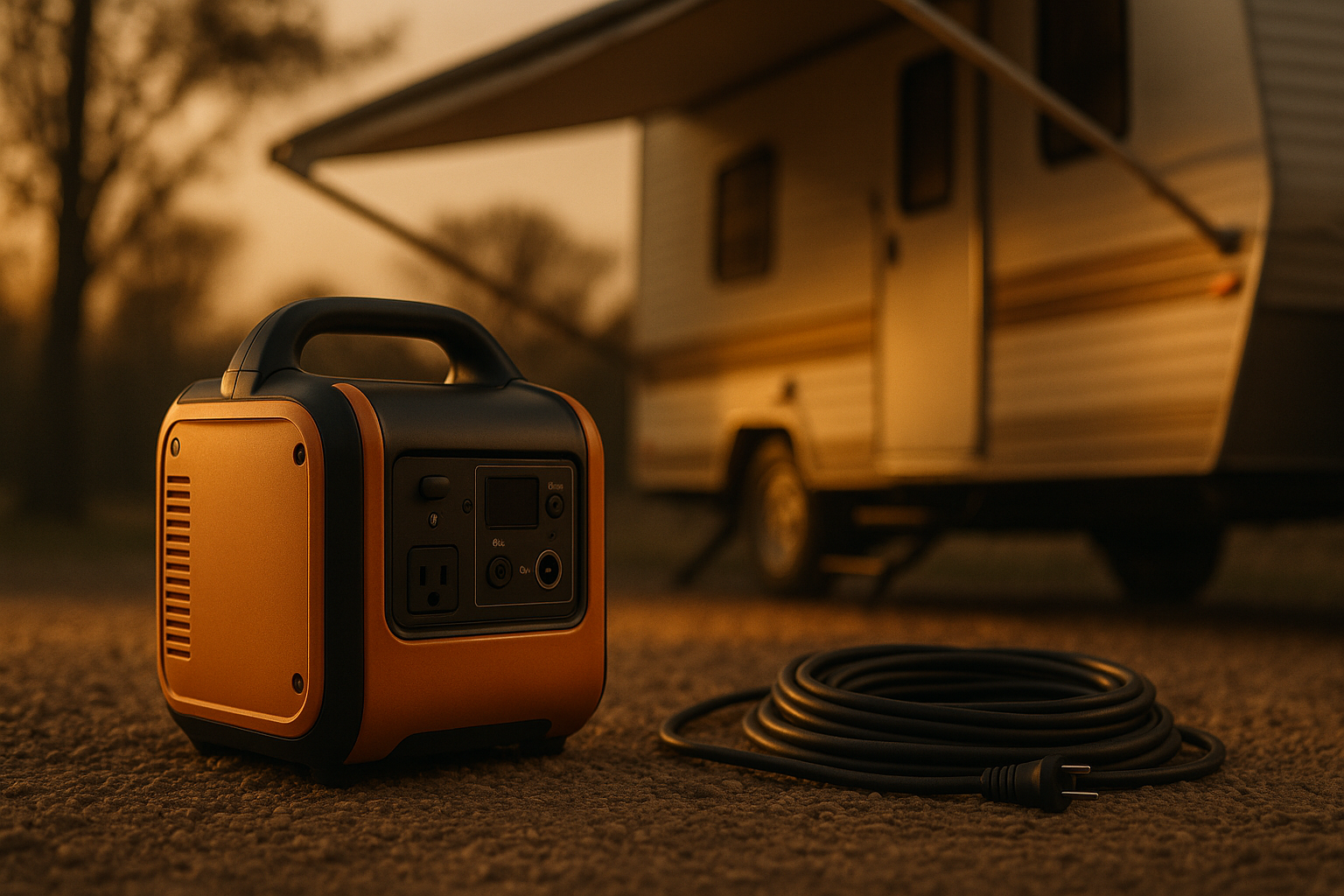
Best Portable Power Stations for RVs: Boondocking Guide 2026

Photo by Zendure Power Station on Unsplash
Best Portable Power Stations for RVs: Boondocking & Off-Grid Guide
RV boondocking—camping off-grid without hookups—demands reliable power for lights, refrigeration, water pumps, and devices. A portable power station bridges the gap between generator noise and solar-only setups, storing energy quietly and efficiently. This guide walks you through capacity needs, real-world runtime, and the top models that RV owners actually rely on for weeks at a time.
Why Portable Power Stations Beat Generators for RVs
Generators are loud, require fuel storage, and emit fumes that bother neighbors and your family. Portable power stations run silently, produce no exhaust, and pair seamlessly with solar panels. Per owner reports across RV forums and YouTube teardowns, modern lithium units outlast lead-acid alternatives by 5–7 years of daily use, and their inverter efficiency (typically 90%+) means less wasted energy.
The trade-off: upfront cost is higher, and capacity is finite. A 5 kWh unit won’t run an air conditioner all day, but it handles essential loads (fridge, lights, water pump, laptops) for 2–4 days before needing a recharge—or indefinitely if paired with solar.
Capacity & Runtime: How Much Do You Actually Need?
Wattage vs. kilowatt-hours (kWh): Wattage is peak draw; kWh is total stored energy. A 2000W microwave pulls 2000W for 2 minutes but only drains 67 Wh. A 600W fridge runs 24/7 and drains energy continuously.
Typical RV daily loads: - LED lights: 100–200 Wh/day - 12V compressor fridge: 1–3 kWh/day (per RV manufacturer specs); 3-way absorption fridge: 10–20 kWh/day if running on 120V heating element - Water pump (on demand): 50–200 Wh/day - Laptop/phones: 100–300 Wh/day - Fan/heater (modest): 500–1500 Wh/day
Total: 500–2500 Wh/day for comfort camping without AC.
For dry camping with essential loads only (no heating), a 3–5 kWh unit lasts 2–4 days. Pair it with 400W+ of solar panels, and you can run indefinitely in sunny weather.
For full-time nomads or winter boondocking in cloudy regions, 10+ kWh (via stacking or a large fixed unit) is more comfortable—but heavier and pricier.
Key Specs to Check Before Buying
Battery chemistry: - LiFePO₄ (lithium iron phosphate): 3000–5000 cycles, safer thermal profile, industry standard. All major brands now use this. - Older Li-ion: fewer cycles, hotter. Avoid unless heavily discounted.
Inverter power (peak watts): Must exceed your largest load. A fridge surge can hit 1500W; a microwave 2000W. Aim for 2000W+ minimum for RV use.
Charge time (AC mains): 1–10 hours depending on unit size and charger wattage. Slower is OK if you have solar; faster matters if you’re near town.
Solar input: Look for 400W+ MPPT controller built-in. Cheaper units have 100W MPPT and waste solar potential.
Weight & portability: 50+ lb units stay in the RV; under 30 lbs is van-friendly.
Warranty: 3–5 years is standard. Longer is a confidence signal but doesn’t reduce real-world failure risk.
Top Portable Power Stations for RVs
EcoFlow Delta Pro 3.6 kWh: Best for Scalability
The Delta Pro stacks up to 10.8 kWh via Smart Battery modules, and its 3000W pure sine inverter handles most RV loads without flinching. Per owner reports on r/vandwellers and YouTube reviews, the unit pairs seamlessly with solar and recharges from AC in 2–3 hours. The app-based load management is polished.
Trade-off: high upfront cost for the base unit; stacking adds bulk. Best for RVers who plan long-term and want modular expansion.
Bluetti AC500 + B300S 3 kWh: Best for Couples & Small RVs
The AC500 is a 5000W inverter hub; pair it with one B300S battery (3 kWh) for a 3 kWh system, or two B300S units for 6 kWh total. It’s modular—you can start small and add batteries later. Per Bluetti’s spec sheet, the system supports 2400W solar input. Wall-mount the AC500 to save floor space in tight Class B vans.
Real-world feedback from RV forums shows the combo handles 240V split-phase loads (rare in RVs but useful if you ever upgrade). Runtime on 3 kWh covers 2–3 days of moderate use.
Jackery Explorer 1000 v2: Best Budget-Friendly Mid-Tier Option
1 kWh capacity, 2000W inverter, ~28 lbs. Based on aggregated Amazon owner reviews and r/campinggear threads, this unit is bulletproof for weekend trips and light boondocking. Recharges in 2 hours from AC. The price tier is mid-range, making it accessible to RVers testing the waters.
Limitation: 1 kWh runs out in 1–2 days on moderate loads. Pair with solar or plan frequent town visits.
EcoFlow River 3 Pro 720 Wh: Best for Weight-Conscious Nomads
720 Wh, 19 lbs, 1600W inverter. Per manufacturer spec sheet, this recharges fully in 1 hour from AC—handy if you’re parked near a coffee shop. The compact footprint fits Class B vans and truck campers. Runtime: 1 day on moderate loads.
Not a primary power source for week-long boondocking, but excellent as a backup or for short trips. Pairs well with solar for extended trips.
Bluetti EP500Pro 5 kWh: Best for Fixed Installation & Solar Integration
5 kWh built-in, 3000W inverter, integrated 600W MPPT solar controller. Wall-mountable (saves floor space). Per Bluetti’s documentation, the UPS mode switches to battery in <20 ms if AC power drops—useful if you’re parked at an RV resort with spotty shore power.
Best for full-time RVers who want a semi-permanent setup. Heavier (~150 lbs) and pricier, but the integrated solar controller eliminates a separate device.
Real-World Boondocking Scenarios
Scenario 1: Couple, 5-day desert camp, no solar. - Load: 1200 Wh/day (fridge, lights, fans, laptops). - Need: 6 kWh minimum (5 days × 1.2 kWh + 20% buffer). - Pick: EcoFlow Delta Pro 3.6 kWh (stack two units for 7.2 kWh) or Bluetti AC500 + two B300S batteries (6 kWh). Choose stacking if you want modular expansion; choose Bluetti if you prioritize wall-mount space savings.
Scenario 2: Solo van lifer, 2-week trip, 400W solar. - Load: 800 Wh/day average (minimal heating, solar tops up daily). - Need: 3–5 kWh capacity. - Pick: Jackery Explorer 1000 v2 or EcoFlow River 3 Pro 720 Wh. Solar recharges overnight; you’re golden.
Scenario 3: Family RV, winter boondocking, cloudy weather. - Load: 2500 Wh/day (heater running, multiple devices). - Need: 10+ kWh or a gas backup. - Pick: EcoFlow Delta Pro stacked to 10.8 kWh + 600W solar. Or accept generator use 2–3 nights/week.
Pairing Power Stations with Solar Panels
A portable power station alone is finite; solar makes it renewable. Per long-running threads on r/boondocking, most RVers add 400–600W of panels and a dedicated MPPT controller (or buy a unit with one built-in). In summer, 400W of panels recharges a 3 kWh station in 6–8 hours, assuming 5 peak sun hours and 80% system efficiency. In winter or cloudy regions, expect 50% less output.
Maintenance & Longevity Tips
- Store charged (20–80%) in cool, dry conditions if not in use for months. Lithium doesn’t like 0% or 100%.
- Avoid repeated full discharge. Aim to recharge at 30–50% remaining capacity.
- Keep firmware updated. Bluetti and EcoFlow release stability patches; check their apps quarterly.
- Clean vents monthly to prevent thermal throttling in dusty campgrounds.
Per manufacturer specs (typically 3000–5000 cycles at 80% depth of discharge), modern LiFePO₄ units last 10+ years in typical RV use with daily cycling and moderate temperatures.
Budget Tiers & When to Upgrade
- Budget tier (under mid-range): Jackery Explorer 1000 v2, EcoFlow River 3 Pro 720 Wh. Good for weekends, light boondocking, or as a second unit.
- Mid-tier (mid-range to premium-tier): EcoFlow Delta Pro 3.6 kWh (single battery), Bluetti AC500 + one B300S 3 kWh. Sweet spot for couples, 1–2 week trips, solar-ready.
- Premium tier (premium and above): Bluetti EP500Pro 5 kWh, EcoFlow Delta Pro stacked. Full-time RVers, winter camping, or those who want zero fuel dependence.
Don’t overspend on capacity you won’t use. A solo camper with solar needs 3 kWh; a family without solar needs 10+.
FAQ
Q: What’s the difference between an MPPT and PWM solar controller? A: MPPT (Maximum Power Point Tracking) adjusts voltage dynamically to extract 90%+ of available solar power. PWM (Pulse Width Modulation) is simpler but wastes 10–30% in heat. For RV solar, MPPT is worth the extra cost if you’re running 400W+ of panels. Most modern power stations include MPPT built-in.
Q: Can I use a power station with a generator simultaneously? A: Yes. Many units support pass-through charging, meaning a generator can power loads and charge the battery at the same time. Check your unit’s spec sheet for “pass-through charging” or “simultaneous input/output.” This is useful if you want to run high-draw appliances (microwave, heater) while topping up the battery.
Q: Do I need a battery management system (BMS)? A: All modern lithium units have one built-in. It prevents overcharge, over-discharge, and thermal runaway. You don’t need a separate device.
Q: How often should I use the power station to keep the battery healthy? A: Monthly discharge-recharge cycles are ideal. If stored for 3+ months, charge to 50% and check every 90 days. Daily use (RV boondocking) is the healthiest scenario.
Q: Can I charge a power station while running loads? A: Yes. Most units support pass-through charging (AC input powers loads while also charging the battery). Check the spec sheet; not all models support it.
Closing: Choose Based on Your Boondocking Style
Portable power stations have matured into reliable, quiet alternatives to generators for RV camping. The best choice depends on trip length, solar access, and budget. A couple doing 5-day desert trips needs 3–5 kWh; a full-time nomad with solar needs 5–10 kWh; a winter boondocker in the Pacific Northwest might want 10+ kWh plus a backup generator.
Start with capacity math (daily load × days between recharges), add 20% buffer, then pick a unit from the mid-tier or better. Pair it with 400W+ of solar if you’re staying longer than a week, and you’ll enjoy silent, fume-free boondocking for years.