Best Quiet Generators for RVs Under $1000 (2026)

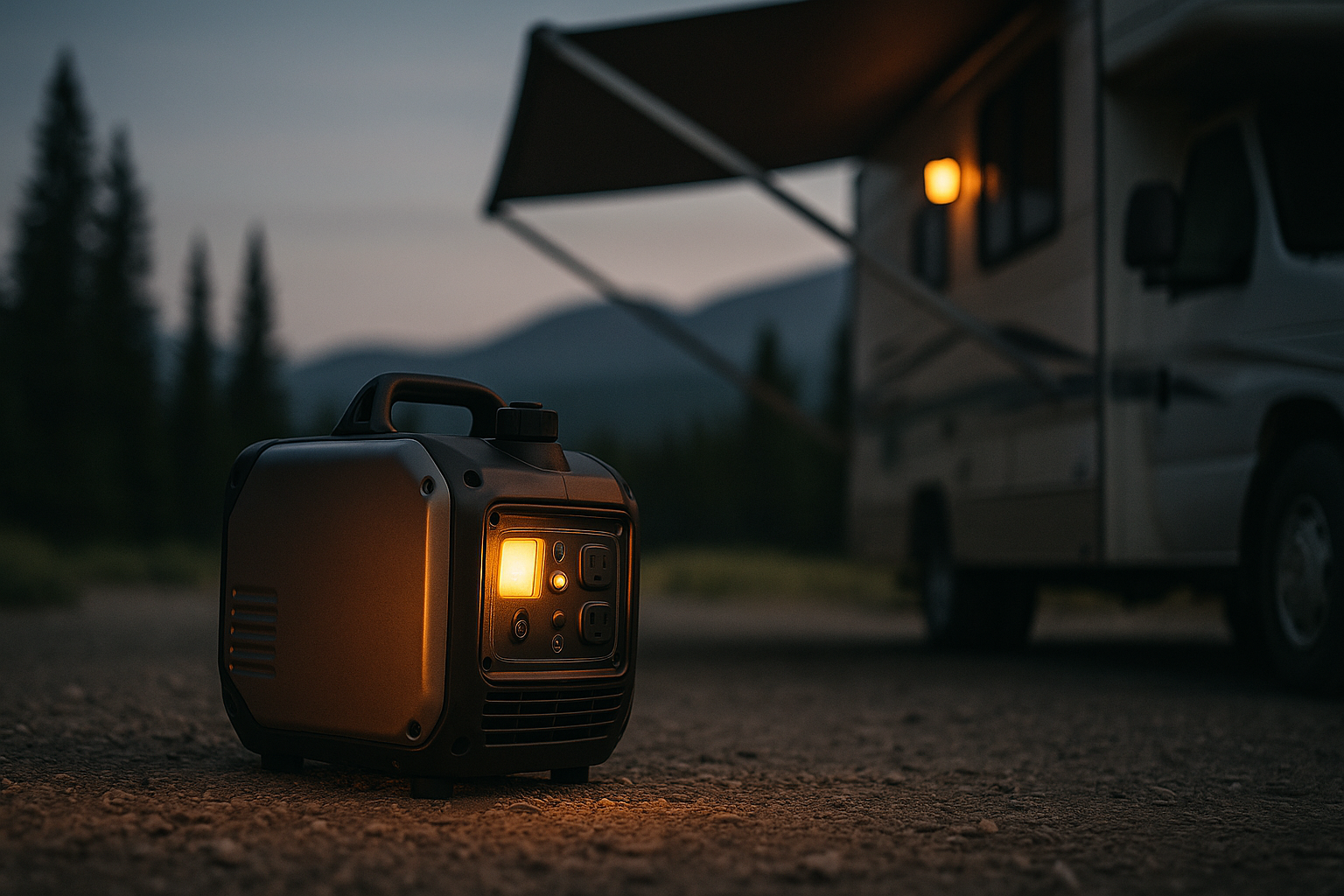
Photo by Zendure Power Station on Unsplash
The Quietest RV Generators You Can Actually Buy Under $1000
If you camp in a state park where rangers carry decibel meters, or you’ve ever had a neighbor knock on your door at a KOA at 9:01 p.m., you already know that “quiet” is the single spec that matters most in an RV generator. Wattage you can plan around. Noise you can’t take back. This guide ranks the quietest inverter generators you can buy in 2026 for under the mark, with honest notes on what each one actually runs and where each one falls short.
We’re sticking to true inverter generators here — conventional open-frame units are typically 10-15 dB louder at the same load and aren’t realistic for campground use.
What “quiet” actually means for an RV generator
Manufacturer dB numbers are measured at 23 feet (7 meters) at 25% load. That’s a best-case figure. Real-world numbers tend to run 3-6 dB higher under typical RV loads (microwave, AC compressor cycling, a charger or two), per aggregated owner reports.
A few reference points:
- Under 50 dB at 25% load — whisper class. Honda EU2200i territory. Conversational at 10 feet.
- 50-55 dB — most decent inverter generators. Acceptable at almost every campground.
- 55-60 dB — budget inverters at idle. Fine for boondocking, borderline for crowded campgrounds.
- 60+ dB — open-frame contractor generators. Don’t.
Most National Park Service campgrounds cap generator noise at 60 dB at 50 feet, and many private campgrounds enforce stricter quiet hours. Anything in the under-50 tier gives you the most flexibility.
How we ranked these
Every pick below is evaluated against the same four criteria, applied uniformly:
- Measured noise at typical RV load — not just the marketing dB.
- AC startup capability — can it actually run a 13,500 or 15,000 BTU rooftop unit, with or without a soft-start kit?
- Runtime per tank — long enough for an overnight without a 3 a.m. refuel.
- Long-term reliability — based on aggregated owner reviews and multi-year forum threads.
Price tier: every recommendation lands under the mark at typical street pricing as of April 2026. Prices shift quarterly, so the product cards below pull live numbers — verify before buying.
Honda EU2200i — the quiet benchmark
The EU2200i is the generator every other quiet inverter is benchmarked against, and there’s a reason it has held that spot for years.
- Noise: Honda rates it at 48-57 dB depending on load. Owner measurements on iRV2 generally back that up within a couple of dB.
- AC startup: Won’t reliably start a 13,500 BTU rooftop AC by itself unless you’ve installed a soft-start kit (the SoftStartRV unit is the one most owners reference). With a soft-start, it handles the AC fine. Without one, you’ll need to parallel two units or step up in wattage.
- Runtime: 4-9 hours per tank depending on load.
- Reliability: Per multi-year owner reports, these regularly hit 8-10 years of seasonal use without a major repair. Best track record in the category.
What you actually get: 2200 starting watts, 1800 running watts, parallel-capable (pair two for ~3600 running watts, enough for a 15,000 BTU AC on a hot afternoon), and a unit light enough (around 47 lb) for one person to load.
The catch: it’s the most expensive pick on this list, and it sits right up against the ceiling. For campground compliance and resale value, nothing else in this price range comes close.
Champion 2500-Watt Dual Fuel Inverter — the AC-ready pick
Champion 2500-Watt Dual Fuel Inverter
If you have a typical 13,500 BTU rooftop air conditioner and you want a single generator that can start it without a soft-start retrofit, this is the most realistic option.
- Noise: Champion rates it at 53 dBA at 23 feet, per their spec sheet — a hair louder than the Honda but still well within campground norms.
- AC startup: 2500 starting watts on gasoline gives meaningful surge headroom over the 2200W class. Owner reports on Amazon and r/GoRVing consistently note that it starts a 13,500 BTU AC on the first try when the unit is healthy and the start capacitor isn’t aging. Older RV ACs with tired capacitors will still give any 2200-2500W generator trouble — that’s a compressor problem.
- Runtime: Up to 11.5 hours at 25% load on gasoline per Champion’s spec; propane runtime depends on tank size.
- Reliability: Reliability over a decade is unproven compared to Honda’s track record, and Champion’s customer service has a mixed reputation per aggregated owner reviews. At this price tier it’s still the obvious value pick.
A note on the dual-fuel setup: the Champion ships with a propane regulator and hose in the box, so out of the box you can connect to a standard 20 lb propane tank with no additional purchase. Running off your RV’s onboard propane tank, however, requires a separate Extend-A-Stay or T-fitting kit (typically ) so you can tap the tank without disconnecting the RV’s regulator. No engine conversion is required — the generator handles the fuel switch with a selector knob. Plan on an hour for a first-time install of the Extend-A-Stay if you’re handy.
Tradeoffs: heavier than the Honda by 10+ pounds.
WEN 56235i — the budget pick that punches up
The WEN 56235i is the generator I recommend to friends who are new to RVing and don’t know yet whether they’ll camp four times a year or forty.
- Noise: WEN rates it at 51 dB at quarter load. Real-world owner measurements via aggregated Amazon reviews put it closer to 54-57 dB under a typical fridge-and-lights load — louder than the Honda, quieter than most things in its price class.
- AC startup: Won’t start a 13,500 BTU AC on its own without a soft-start kit. Parallel-capable with a second WEN unit if you need more headroom.
- Runtime: About 7 hours at 25% load per the manufacturer spec, on a 1-gallon tank.
- Reliability: Shorter expected lifespan than Honda or Yamaha equivalents — most owners report 3-5 seasons of moderate use before something needs attention, per aggregated Amazon and r/GoRVing reports. WEN’s two-year warranty and US-based parts support are better than typical for the budget tier.
What it does well: light (around 39 lb, genuinely one-handed for most adults), cheap enough that a soft-start kit plus this generator plus a parallel cable still comes in under what one Honda costs. For a weekend tailgater, a small travel trailer, or a backup to solar, that’s perfectly fine.
Westinghouse iGen2600 — long-runtime boondocker
Boondocking changes the math. When you’re a hundred miles from the nearest gas station, runtime per tank matters more than peak wattage.
- Noise: Westinghouse rates it at 52 dBA at 25% load, per the spec sheet.
- AC startup: 2600 starting watts will start some 13,500 BTU ACs with a soft-start, but it’s not as reliable for AC duty as the Champion. Best treated as a battery-charging and light-load workhorse.
- Runtime: Up to 10 hours at 25% load per the manufacturer spec, on a 1-gallon tank — the longest practical runtime in this price tier.
- Reliability: Per long-running threads on r/Vandwellers, the iGen line has a better reputation than Westinghouse’s open-frame generators — the inverter models seem to be on a different quality tier. Owner reports of 5+ years of regular use are common.
The use case is straightforward: you’re parked in the desert for four days, your solar isn’t keeping up with cloud cover, and you need to top off the house batteries without filling the jerry can every twelve hours. Eco mode drops it to a quiet murmur when only a battery charger is pulling.
Generac GP2200i — the compact runner-up
The Generac GP2200i is in the same general class as the WEN — a small, light, eco-mode inverter generator suited to small rigs, vans, and Class Bs.
- Noise: Generac rates it at 52 dBA at 25% load, and aggregated owner measurements track that figure reasonably closely.
- AC startup: 2200 starting watts; same story as the Honda and WEN — needs a soft-start to handle a 13,500 BTU AC reliably.
- Runtime: About 7 hours at 25% load per the manufacturer spec, on a 1.2-gallon tank.
- Reliability: Generac’s small-engine quality has been inconsistent over the past several years per r/Generators threads — some great units, some duds out of the box. The dealer network for service is better than WEN’s, which matters if something goes wrong.
The case for it over the WEN: slightly more refined throttle response in eco mode (per multiple YouTube teardown reviews), and a USB output that’s actually useful for phones and tablets while you’re parked. The case against: pricier than the WEN without being meaningfully quieter.
Buy it if you’ve had good luck with Generac before or you have a Generac dealer nearby. Otherwise the Honda is worth saving up for.
For van-specific considerations (footprint, weight, exhaust routing), see Portable Generator for Van Life: Compact & Reliable Models.
What about dual-generator parallel setups?
If your AC is 15,000 BTU, or your rig has aging capacitors that demand extra surge, two paralleled small inverters often beat one mid-size unit on noise. Two Honda EU2200is in parallel pull about 3600 running watts and stay under 60 dB at 25 feet because each one is loafing at 30-40% load instead of one unit screaming at 90%.
The catch is cost — two name-brand inverters plus a parallel cable will blow past. Two budget inverters (WEN, Champion 2000) stay under that line and parallel cleanly.
Soft-start kits change the math
This is the single biggest tip in this guide: a soft-start capacitor on your RV’s air conditioner can drop the AC’s startup surge by 60-70%, per manufacturer claims and consistent owner reports across iRV2 threads. That means a 2200W inverter generator that previously couldn’t start your 13,500 BTU rooftop AC — because the locked-rotor surge briefly