Portable Solar Panels for Camping: Reviews & Buyer's Guide

Photo by Jackery Power Station on Unsplash
Portable Solar Panels for Camping: Reviews & Buyer’s Guide
Portable solar panels let you recharge power stations, phones, and laptops anywhere the sun reaches—no gas, no noise, no fuel to carry. But output claims vary wildly, and real-world performance depends heavily on angle, cloud cover, and panel quality. This guide cuts through the marketing to show you what actually works in the field.
Why Portable Solar Panels Matter for Camping
A portable solar panel transforms a power station or battery pack from a one-trip consumable into a renewable source. On a week-long camping trip, you’re no longer counting down your stored wattage; you’re harvesting it daily.
The appeal is obvious: silent, zero-emission charging that works anywhere daylight reaches. But the catch is equally real. Advertised wattage assumes perfect 90-degree sun angle, zero clouds, and new cells—conditions almost never met in real camping scenarios. A panel rated 100W might deliver 60–75W on a partly cloudy afternoon, and much less if it’s angled wrong.
Understanding this gap between spec and reality is the difference between a useful tool and an expensive paperweight.
Panel Types: Foldable vs. Rigid vs. Built-in
Foldable panels dominate the camping market because they pack small and weigh little. Most use monocrystalline cells (higher efficiency per square inch) sandwiched between fabric or thin plastic covers. They fold to briefcase or backpack size, making them ideal for backpacking or van life. Brands like Anker and Goal Zero primarily use monocrystalline; brands like Renogy and some budget models occasionally use polycrystalline cells to reduce cost, though this reduces output per square inch.
Rigid panels (aluminum-framed, glass-faced) are heavier but more durable and efficient. They resist punctures and UV degradation better, handle repeated setup/teardown without creasing, and often come with adjustable kickstands. Car campers and RV owners favor these because weight and pack size matter less.
Built-in panels (integrated into power station lids or backpack straps) are convenient but usually underpowered. A 50W panel sewn into a backpack is portable but slow to charge anything substantial. They work as supplemental trickle-chargers, not primary power sources.
For camping specifically, foldables and rigid panels both work; choose based on your trip length and vehicle. Backpacking? Foldable. Car camping? Rigid or large foldable.
Key Specs That Actually Matter
Wattage rating is the headline number—but it’s measured under Standard Test Conditions (STC): 1,000 watts per square meter of irradiance, 25°C cell temperature, air mass 1.5. Real sunlight is messier. Expect 50–75% of rated output on average sunny days, and 20–40% on cloudy ones.
Cell type matters more than wattage alone. Monocrystalline cells (single-crystal silicon) convert ~18–22% of sunlight to electricity. Polycrystalline cells (~15–17%) are cheaper but less efficient per square inch. Most portable panels now use mono because the weight/efficiency trade-off favors it.
Voltage and connector compatibility determine what you can charge directly. Most camping panels output 5V (USB) and 18V (DC barrel jack or XT60 connectors). If you own a specific power station, confirm the panel’s connectors match before buying. Mismatches mean buying adapters or leaving the panel’s full output unused.
Temperature coefficient tells you how much output drops per degree Celsius above 25°C. Most portable panels are rated around –0.4% per °C, meaning a panel in 45°C sun (common in desert camping) loses 8% efficiency. Rigid, glass-faced panels often have better coefficients than thin foldables.
Durability ratings: look for IP65 or IP67 water resistance (dust and water-jet proof). Fabric-backed foldables are typically IP54 (splash-resistant but not waterproof). If you’re camping in rain, a rigid panel with a protective case is safer.
Real-World Performance: What Owners Report
Based on owner reports from r/CampingGear, r/SolarDIY, and verified Amazon reviews, here’s what actually happens in the field:
- 100W foldable panels typically deliver 60–80W in good sun, 30–50W in partial shade, and 10–20W on overcast days. Charging a mid-capacity power station (1,000–2,000 Wh) takes 8–12 hours of sunlight.
- 200W rigid panels are closer to spec in good conditions (150–180W) but still drop 40–50% on cloudy days. A 2,000 Wh station charges in 5–7 hours of peak sun.
- Angle matters enormously. Panels aimed straight at the sun (perpendicular to rays) output 30–50% more than flat-on-ground placement. Adjustable kickstands are worth the extra weight for multi-day trips.
- Morning and evening sun is weak. A panel angled at mid-day sun from 10 AM to 4 PM delivers most of the day’s charge; before 10 and after 4, output drops sharply.
Owners on r/CampingGear and r/SolarDIY consistently report that mid-tier panels (150–200W) hit a sweet spot: enough output to meaningfully charge a power station in one sunny day, light enough to carry on a vehicle, and durable enough for repeated trips.
Comparing Top Portable Solar Panels
High-Efficiency Monocrystalline Panels (150W+)
Rigid-frame panels with monocrystalline cells deliver the fastest charging speeds and best durability. These are best for car camping, RV trips, or base camps where weight and pack size are not constraints.
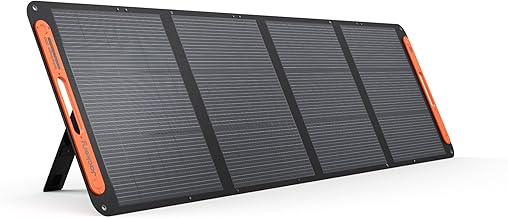
This rigid, two-panel design folds into a briefcase-sized case. Per owner reports, it consistently delivers 150–180W in direct sun and handles angle adjustments via built-in kickstand. The XT60 connector fits Jackery power stations directly; other brands require an adapter. Owners report 4–5 hours to charge a 2,000 Wh station in good conditions. The aluminum frame and tempered glass resist punctures and UV damage better than fabric-backed foldables, and the case protects during transport.
Ultra-Lightweight Foldables (Under 2 lbs)
For backpacking and ultralight trips, foldable panels under 2 lbs let you add solar without blowing your pack weight budget.
Weighs 1.6 lbs and folds to the size of a paperback book. Monocrystalline cells deliver around 40–50W real-world output in good sun (rated 100W). Multiple USB-A and USB-C ports let you charge phones, tablets, and small batteries directly without a power station. Owners report it’s durable enough for repeated backpacking trips, though the thin fabric backing is not waterproof—keep it in a dry bag during rain. The low weight makes it a no-brainer addition to any hiking trip.
Best for Low-Light Performance
Monocrystalline cells in certain panel designs perform better in cloudy or partial-shade conditions than others, though no panel performs well in deep shade.
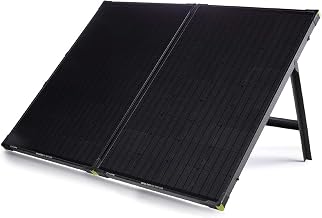
This 200W foldable uses high-efficiency monocrystalline cells and a proprietary design that, per owner reports, maintains output slightly better in diffuse light than competing foldables of the same wattage. It’s heavier (around 5 lbs) than ultralight options but lighter than rigid panels. The USB and 18V outputs work with a wide range of devices. Owners in Pacific Northwest and UK forums report it’s one of the few portables that doesn’t completely tank on overcast days.
Best Value Mid-Range Option
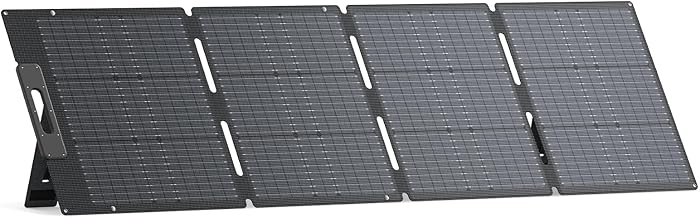
200W output, monocrystalline, rigid frame with kickstand. Per BLUETTI’s spec sheet and owner feedback, it hits the performance-to-cost sweet spot for casual campers. Charges mid-tier BLUETTI power stations in 5–6 hours of good sun. The XT60 connector is standard across many brands. Owners praise the durability and note that the cost is lower than name-brand equivalents without sacrificing efficiency.
Professional-Grade for Extended Trips
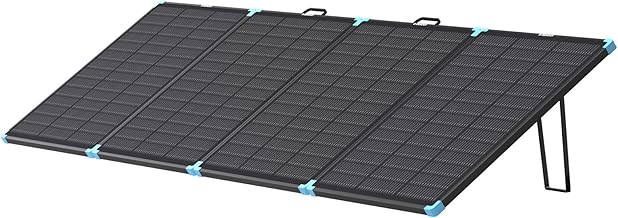
Three 100W monocrystalline panels in a rigid suitcase with built-in connectors and a charge controller. This is overkill for a weekend trip but ideal for off-grid cabins, extended RV trips, or base camps where you’re staying put for weeks. Per Renogy’s documentation and owner reports, it delivers consistent 250–280W in good sun. The integrated controller means you can charge a battery bank directly without a separate MPPT. Weight is around 50 lbs, so it’s vehicle-only.
Charging Speed: How Long Does It Actually Take?
Real charging times depend on three variables: panel wattage, power station capacity, and sunlight conditions. All calculations below account for ~15–20% controller/wiring losses typical of MPPT regulators and cable voltage drop.
Scenario 1: 100W panel + 1,000 Wh power station in good sun - Theoretical: 10 hours (1,000 Wh ÷ 100W) - Real-world: 12–15 hours (accounting for voltage losses, charging curve inefficiency, and sun angle drop-off)
Scenario 2: 200W panel + 2,000 Wh power station in good sun - Theoretical: 10 hours - Real-world: 6–8 hours (larger panels maintain efficiency better, and modern MPPT controllers are more efficient than small USB regulators)
Scenario 3: 100W panel + smartphone in good sun - Theoretical: 5–6 hours (assuming a 5,000 mAh phone battery) - Real-world: 4–5 hours (direct USB charging is more efficient than going through a power station)
The takeaway: a 150–200W panel is the minimum for meaningful daily charging on a camping trip. Smaller panels work for trickle-charging phones but won’t keep a power station topped up.
Durability and Long-Term Performance
Portable solar panels degrade slowly over time. Per manufacturer warranty specifications and long-running owner reports:
- Monocrystalline panels lose ~0.5% efficiency per year under normal use. A 5-year-old 200W panel outputs around 195W in the same conditions.
- Foldable panels risk creasing or puncture damage from repeated fold/unfold cycles. Owners report that panels used weekly hold up for 3–5 years; storage in a protective case extends this.
- Rigid panels last longer (7–10 years per manufacturer warranty) because they don’t flex, but they’re heavier and harder to transport.
- Connectors and wiring are the first failure points. Ensure connectors are rated for outdoor use (UV-resistant, corrosion-resistant). XT60 and Anderson PowerPole connectors are more reliable than proprietary designs.
Angle, Position, and Seasonal Adjustments
A panel’s output is most sensitive to its angle relative to the sun.
- Perpendicular to the sun (90°): maximum output
- 30° off perpendicular: ~85% output
- 45° off perpendicular: ~70% output
- Flat on the ground: 50–60% output (depending on latitude and time of day)
For camping, use an adjustable kickstand and point the panel toward the sun at solar noon (around 1 PM during daylight saving time). Reorient it every 2–3 hours for a full day of charging, or set it once at mid-morning and accept slightly lower afternoon output.
In summer, the sun is higher; angle the panel more upright. In winter, angle it lower. This matters more for stationary setups (RV, cabin) than day trips.
Maintenance and Storage Tips
- Keep panels clean. Dust, pollen, and bird droppings reduce output by 5–20%. A soft cloth and water clean them without scratching.
- Avoid extreme heat. Panels lose efficiency in hot sun; ensure airflow underneath. A panel in 55°C heat outputs 10–15% less than in 25°C.
- Store in a dry place. Foldable panels should be stored flat or loosely rolled, never creased. Rigid panels need a protective case.
- Check connectors annually. Corrosion on XT60 or barrel-jack connectors reduces charging speed. Clean with a pencil eraser or contact cleaner.
- Inspect for damage. Small cracks in cells reduce output but don’t cause immediate failure. Large punctures or delamination require replacement.
FAQ
Q: Can I charge a phone directly from a portable solar panel? A: Yes, if the panel has USB output (5V). Most 50–100W panels can trickle-charge a phone in 4–6 hours of good sun. Larger panels charge faster. Direct charging is more efficient than running power through a battery pack.
Q: Do portable solar panels work on cloudy days? A: Yes, but at 20–40% of rated output. On overcast days, expect very slow charging. Panels work best in clear skies. Monocrystalline panels perform slightly better in diffuse light than polycrystalline, but the difference is modest.
Q: What’s the difference between MPPT and PWM charge controllers? A: MPPT (Maximum Power Point Tracking) controllers are more efficient (~97%) and suit larger panels (150W+). PWM (Pulse Width Modulation) controllers are simpler and cheaper but less efficient (~80%). For camping, MPPT is worth the extra cost if you’re charging a large power station; PWM is fine for phones and small batteries.
Q: How much does a portable solar panel weigh? A: Foldables range from 1.5 lbs (50W ultralight) to 5 lbs (200W). Rigid panels are heavier: 10–15 lbs for 150–200W. Suitcase-style multi-panel setups weigh 30–60 lbs.
Q: Can I use a portable solar panel in winter? A: Yes. Snow and ice reduce output significantly, but a clean panel in winter sun still charges slower than summer. Angle the panel lower in winter (sun is lower on the horizon) and clear snow off regularly for best results.
Q: What’s the warranty on portable solar panels? A: Most brands offer 2–5 year warranties covering defects. Degradation (efficiency loss over time) is typically not covered. Check the fine print; some warranties require registration or proof of purchase.


