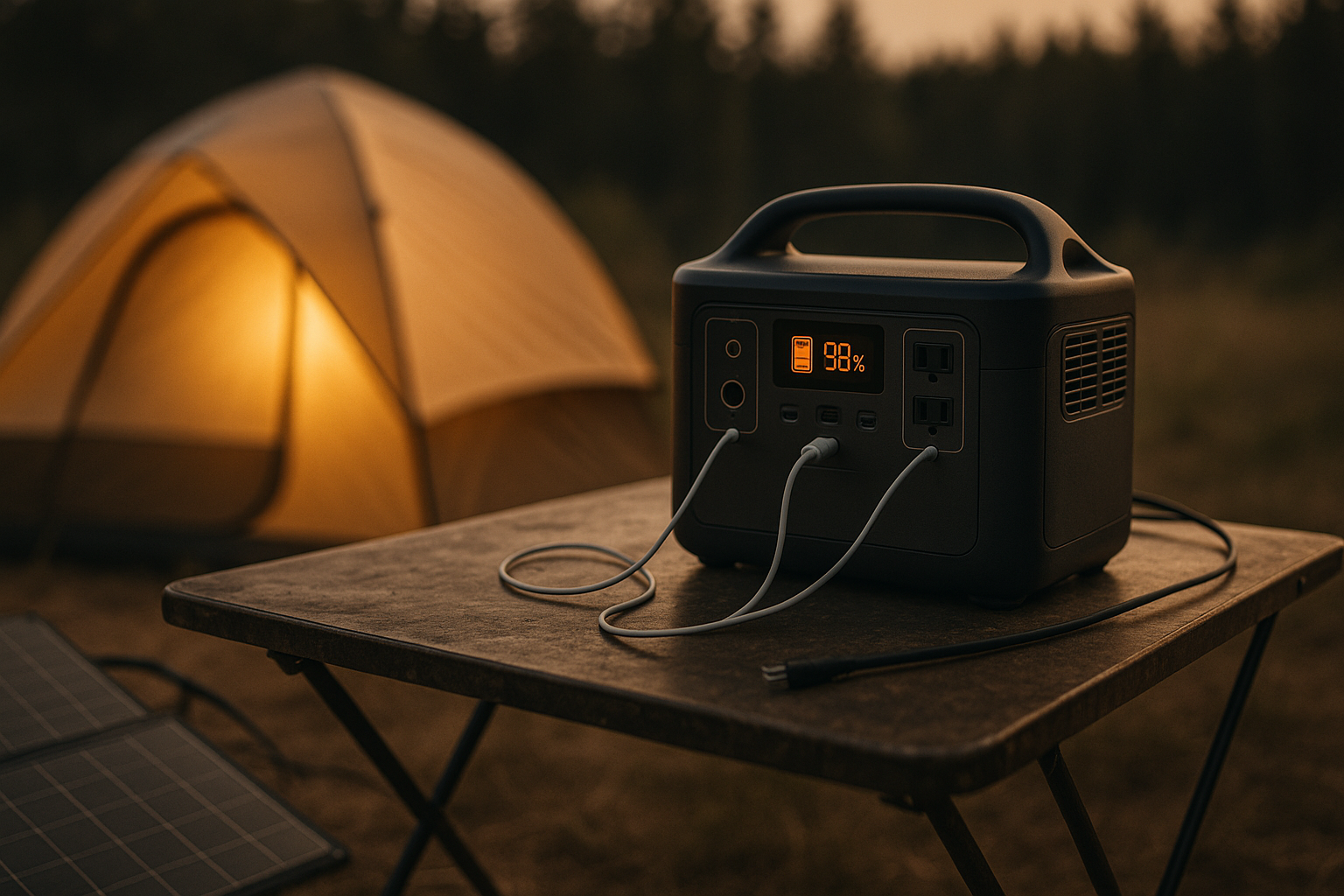
Best Solar Generators for Off-Grid Living 2026

Photo by Jackery Power Station on Unsplash
Best Solar Generators for Off-Grid Living: Complete System Guide 2026
Off-grid living requires a reliable, scalable power system—not just a portable power station. A true solar generator setup for year-round autonomy combines a battery bank, solar array, charge controller, and inverter to handle seasonal load swings and weather variability. This guide walks you through sizing your system, understanding the components, and selecting hardware that won’t strand you in the dark.
Why Solar Generators Are Different for Off-Grid vs. Camping
A camping power station is a grab-and-go tool. An off-grid solar generator is a permanent power infrastructure. The differences matter:
- Capacity scale: Off-grid homes need 10–50+ kWh of usable battery storage to cover multi-day cloudy periods and winter load increases. Camping stations max out at 2–5 kWh.
- Charge speed: Off-gridders can’t rely on wall outlets. Solar input must be high enough (5–10 kW total array) to recharge depleted batteries within available daylight, even in winter.
- Expandability: Modular systems let you add battery modules and panels as your load grows or budget allows.
- Durability: Off-grid systems run continuously, 365 days a year. LiFePO4 chemistry and robust thermal management are non-negotiable.
- Monitoring and control: You need real-time data on battery state-of-charge, solar input, and load to avoid blackouts and manage seasonal swings.
Portable power stations designed for camping (like Jackery Explorer or Goal Zero Yeti) can supplement an off-grid system, but they cannot be your primary power source.
Sizing Your Off-Grid Solar Generator System
Before you buy hardware, you must calculate three numbers: daily energy consumption, peak load, and days of autonomy.
Step 1: Calculate Daily Energy Consumption
List every appliance and its daily run time:
- Refrigerator: 500 Wh/day
- Water pump: 300 Wh/day
- Lighting (LED): 200 Wh/day
- Laptop and devices: 150 Wh/day
- Washing machine (2× weekly): ~600 Wh
- Electric heater or AC: 100–5,000 Wh/day depending on climate zone, square footage, and setpoint temperature
Example: A 1,200 sq ft home in IECC Climate Zone 4 (mixed-humid, e.g., North Carolina) with a 68°F winter setpoint and 78°F summer setpoint would consume ~2,000–3,000 Wh/day for heating/cooling. A similar home in Zone 2 (hot-humid, e.g., Florida) with AC running 8 hours daily would consume 4,000–5,000 Wh/day. Consult your local IECC climate zone and adjust accordingly.
Off-grid baseline: Most homes without heating/cooling use 5–15 kWh/day, based on NREL off-grid home studies. Homes with electric heating/cooling jump to 20–50+ kWh/day depending on your climate zone.
If you’re unsure, assume 10 kWh/day as a conservative baseline for a modest cabin. If you plan to run air conditioning or electric heating, add 15–30 kWh/day depending on your climate zone.
Step 2: Determine Peak Load
Peak load is the sum of your largest simultaneous appliances. If you run a water pump (3 kW), refrigerator (0.8 kW), and lights (0.2 kW) at the same time, your peak is ~4 kW. Your inverter must handle this without shutting down.
Most off-grid inverters are sized at 5–10 kW to handle brief surges.
Step 3: Calculate Days of Autonomy
How many consecutive cloudy days can you tolerate before solar input drops to zero? In most climates:
- Winter: 3–5 cloudy days are common.
- Tropical/monsoon regions: 7–10 days.
Battery capacity formula:
Battery capacity (kWh) = Daily consumption (kWh) × Days of autonomy
Example: 10 kWh/day × 4 days of autonomy = 40 kWh usable storage.
Because lithium batteries should not discharge below 10–20% (to preserve lifespan), add a safety margin: multiply by 1.2–1.3. So your total installed capacity should be ~48–52 kWh.
Core Components of an Off-Grid Solar System
Solar Array
Your solar panels are the primary charge source. Off-grid arrays are typically 5–15 kW, much larger than portable camping panels.
- Sizing rule: 1 kW of solar capacity per 1–2 kWh of daily consumption, adjusted for your geographic location and seasonal insolation. Use the NREL PVWatts calculator (pvwatts.nrel.gov) to estimate production for your latitude and climate. Example: Phoenix, AZ (high insolation) may require only 1 kW per 2 kWh; Anchorage, AK (low insolation) may require 1 kW per 0.8 kWh.
- Panel type: Monocrystalline panels (18–22% efficiency) are standard. Bifacial panels (which capture ground reflection) add 5–10% output but cost more.
- Orientation: South-facing (Northern Hemisphere) at an angle matching your latitude yields year-round production. Adjustable racks let you tilt panels seasonally for 10–15% better winter output.
- Mounting: Roof, ground, or pole-mounted systems. Ground-mounted arrays are easier to maintain and angle-adjust; roof mounts save land but complicate repairs.
Most off-gridders install panels in two separate arrays (east and west-facing, or with different tilt angles) to smooth production across the day and seasons.
Charge Controller
The charge controller regulates current from panels to batteries, preventing overcharge and optimizing charging speed.
- MPPT (Maximum Power Point Tracking): More efficient than PWM for larger systems. MPPT controllers recover 15–25% more energy from panels, especially in cold weather.
- Sizing: Controller amperage must exceed your array’s maximum short-circuit current (Isc). A 10 kW array might have 60–80 A Isc, so you’d use a 100 A MPPT controller.
- Dual-input models: Some controllers accept both solar and wind or hydro input, useful if you have a secondary renewable source.
Common brands: Victron Energy (Multiplus, SmartSolar MPPT), Epever, Outback Power. Expect mid-tier to premium pricing; this is not a place to cheap out.
Battery Bank
Your battery bank stores energy for cloudy days and night use. LiFePO4 (lithium iron phosphate) is the modern standard for off-grid:
- Lifespan: 5,000–10,000 cycles (10–15 years typical), compared to 1,000–3,000 cycles for lead-acid.
- Efficiency: 95%+ round-trip, vs. 80–85% for lead-acid.
- Temperature tolerance: LiFePO4 works in sub-zero climates (with heater modules); lead-acid capacity drops sharply below 32°F.
- Maintenance: Zero. Lead-acid requires watering and equalization.
Capacity tiers: - Budget: 10–20 kWh (small cabin, minimal loads) - Mid-range: 20–50 kWh (typical off-grid home) - Premium: 50+ kWh (high-load or luxury off-grid property)
Modular systems (like EcoFlow or Bluetti) let you add battery modules incrementally. Integrated systems (like Generac PWRcell or Tesla Powerwall) are fixed-size but simpler to install.
Inverter/Charger
The inverter converts DC battery power to 120/240V AC for your home. For off-grid, you need a hybrid inverter/charger that also handles solar input and can switch between battery and grid power (if available).
- Sizing: Inverter capacity must exceed peak load. A 10 kW inverter is typical for off-grid homes.
- Split-phase output: 240V split-phase inverters let you run large appliances (electric cooktop, water heater) without undersizing.
- Stacking: Two inverters can be stacked for redundancy or to double capacity.
Brands: Victron MultiPlus, Outback Radian, Magnum Energy, Schneider Conext.
Monitoring and Controls
Real-time monitoring prevents blackouts and optimizes charging:
- Battery monitor: Tracks state-of-charge, current draw, and remaining runtime. Victron BMV-712 is the industry standard.
- System controller: Integrates solar, battery, and inverter data. Victron Cerbo GX or similar gives you a dashboard and remote access via phone.
- Load shedding: Automatic disconnect of non-essential loads (water heater, EV charger) if battery drops below 20% to preserve reserves.
System Design Examples for Different Scenarios
Small Off-Grid Cabin (5 kWh/day, 3 days autonomy)
- Battery: 20 kWh LiFePO4 (e.g., Bluetti AC500 + B300S with one module)
- Solar array: 5 kW (15–20 panels at 330 W each)
- Inverter: 5 kW hybrid inverter
- Charge controller: 60 A MPPT
- Installed cost:
Medium Off-Grid Home (12 kWh/day, 4 days autonomy)
- Battery: 50–60 kWh LiFePO4 (e.g., EcoFlow Delta Pro with expansion modules, or Bluetti with 2–3 battery units)
- Solar array: 10 kW (30 panels at 330 W)
- Inverter: 8–10 kW split-phase hybrid
- Charge controller: Dual 100 A MPPT controllers
- Installed cost:
Large Off-Grid Property (25 kWh/day with heating, 5 days autonomy)
- Battery: 150+ kWh LiFePO4 (integrated system like Generac PWRcell or custom LiFePO4 stack)
- Solar array: 20+ kW (roof + ground-mounted)
- Inverter: 15–20 kW three-phase or dual split-phase
- Charge controller: Multiple 150+ A MPPT units
- Secondary source: Wind turbine or hydro to smooth winter production
- Installed cost: +
Seasonal Optimization and Load Management
Off-grid systems must adapt to seasonal swings:
Winter Strategy
- Solar input drops 30–50% due to low sun angle and cloud cover.
- Battery discharge increases if you use electric heating.
- Solution: Oversized solar array (designed for winter minimum production), larger battery bank, or secondary renewable source (wind, hydro, backup generator).
Summer Strategy
- Excess solar production charges batteries fully by mid-morning.
- Load drops (no heating).
- Solution: Divert excess solar to water heating, EV charging, or dump loads to avoid overcharging. Some systems use a “diversion controller” to send excess power to a water heater element.
Load Shifting
Run high-consumption tasks during peak solar hours: - Wash clothes mid-day. - Charge EVs or power tools when sun is strong. - Defer non-essential loads (pool pump, irrigation) to sunny afternoons.
Recommended Off-Grid Solar Generator Systems
For Year-Round Autonomy with Expandability
The Delta Pro is designed as a modular off-grid backbone. It starts at 3.6 kWh and scales to 25+ kWh with battery modules. Dual 400 W solar inputs and a 3.6 kW inverter handle most off-grid loads. The system includes a battery management system and app monitoring. Owner reports indicate reliable cold-weather performance and straightforward expansion, though the premium pricing reflects the modularity. Best for homeowners who plan to expand over time.
For Established Off-Grid Homes with High Capacity Needs
The AC500 is a 5 kW hybrid inverter/charger that pairs with stackable B300S battery modules (3.1 kWh each). You can install 4 modules for 12.4 kWh or scale to 13.6 kWh with expansion. Dual MPPT controllers and split-phase 240V output suit larger homes. Per manufacturer specifications, the AC500 is reliable in harsh climates and supports load-shedding automation. Initial cost is moderate; expandability is excellent.
For Cabins and Small Properties
Important caveat: The Jackery Explorer 2000 Pro is a portable power station, not a primary off-grid solution. It can supplement a full off-grid system or serve as emergency backup. If your off-grid load is modest (5–8 kWh/day), you must pair it with a separate solar array and charge controller for year-round autonomy. The Explorer 2000 Pro offers 2 kWh capacity, 2.4 kW inverter, and accepts up to 1.2 kW solar input. Owners report 5+ years of daily use in remote cabins when used as part of a complete system.
For Maximum Capacity and Integrated Control
Integrated LiFePO4 battery boxes with built-in management and inverter options are available from multiple manufacturers. A 5.1 kWh unit can be stacked to 20+ kWh. These are simpler to wire than discrete components but offer less flexibility. Per manufacturer specifications, they are reliable for off-grid use but typically require professional installation.
Installation and Permitting
Off-grid solar installations vary by jurisdiction:
- Permitting: Most counties require building permits and electrical inspection. Budget 4–12 weeks for approval.
- Grid-tie vs. off-grid: Grid-tie systems (with battery backup) are simpler to permit than full off-grid. Off-grid may require proof of sufficient solar/battery capacity.
- Installer costs: Professional installation runs 30–50% of total system cost. A system may to install. DIY is possible if you have electrical knowledge; mistakes are expensive.
- Interconnection: If you ever connect to the grid later, your system must meet interconnection standards (anti-islanding, voltage regulation).
Consult your county planning office and a licensed solar installer before purchasing components.
Maintenance and Longevity
LiFePO4 systems require minimal upkeep:
- Annual: Inspect wiring, tighten connections, check solar panel output against expected production for your season.
- Battery health: Monitor state-of-charge trends. Capacity loss of 5–10% over 10 years is normal.
- Inverter: Check cooling fans and thermal sensors. Most inverters last 10–15 years before needing replacement.
- Solar panels: Clean panels 1–2 times yearly in dusty climates. Output should remain 80%+ of rated capacity after 25 years.
Keep manufacturer documentation and service records for warranty claims.