As an affiliate, we may earn from qualifying purchases. This doesn't affect which products we recommend.
The Cheapest Solar Generator for Camping That Actually Holds Up
If you want the shortest honest answer: the cheapest solar generator worth buying for camping is a 200–300Wh lithium iron phosphate (LiFePO4) power station paired with a 60–100W folding solar panel. Anything cheaper than that tier tends to be a lead-acid relic or a no-name lithium-ion unit that won’t survive a second season. Below is what to actually buy, what to skip, and how to size it so you don’t get burned.
What “cheapest” should actually mean here
“Cheapest” gets gamed hard in this category. You’ll see listings on Amazon claiming “500W solar generator” — they’re usually 150Wh lithium-ion bricks with a tiny 18W panel and a one-year warranty that evaporates when you email support. That’s not cheap; that’s expensive per usable camping trip.
The honest definition: the lowest-priced unit that will (1) survive 500+ charge cycles, (2) run your actual camping load for a night, and (3) recharge from the sun in a reasonable amount of time. That floor lives in the budget-tier-to-low-mid-range bracket, not below it.
Sizing: how small can you actually go?
Before picking a unit, add up what you’ll plug in. Most weekend campers underestimate this and then blame the generator.
Typical camping loads per device manufacturer spec sheets:
Phone charge: 10–20Wh per full charge
LED string lights or lantern: 5–10W continuous
12V fridge (small, like Alpicool C15): 30–45W when compressor runs, roughly 200–400Wh per day depending on ambient temp
CPAP without humidifier: 30–60W while running, ~200–400Wh per night
Small fan: 5–15W
Laptop: 30–60W while in use
If you’re only charging phones and running lights, a 200–300Wh unit covers two nights easily. Add a CPAP or fridge and you’re in 500Wh+ territory, a different price tier.
Why LiFePO4 matters even on a budget
Two battery chemistries dominate this market: standard lithium-ion (NMC) and lithium iron phosphate (LiFePO4). The cheapest units are almost always NMC because the cells are cheaper. But:
NMC units in the same price bracket are often rated for 500–800 cycles to 80%. The original NMC Jackery Explorer 240 spec sheet listed 500 cycles to 80%, which is representative of the NMC tier.
LiFePO4 also tolerates cold mornings and hot car interiors better, which manufacturers note in the operating-temperature ranges on those same spec sheets.
Translation: a LiFePO4 unit that costs slightly more up front is the cheaper unit over five years of weekend trips. The cycle-life math is brutal for NMC at this tier.
Top picks: cheapest units that actually survive
These are ordered roughly cheapest to most expensive within the “actually works” floor. Live prices show in each product card — I’m not going to quote numbers that will be wrong by next month.
256Wh LiFePO4, 200W AC inverter (with 300W surge per Anker’s spec sheet). The smallest unit I’d recommend without caveats. Two AC outlets, USB-C PD output for laptop charging, and Anker’s 5-year warranty — unusual at this tier. Owners on Amazon consistently note it survives being thrown in a trunk for years.
Limitations: 200W inverter means no coffee maker, no hair dryer, no electric kettle. If that matters, size up.
The v2 finally moved to LiFePO4, which is the only reason it’s on this list — the original NMC Explorer 240 wasn’t worth it past 2024. ~256Wh, 300W inverter, easy to read display. Jackery’s support is responsive based on aggregated Amazon owner reviews, which matters if anything goes wrong.
This is the unit I hand to friends who just want something that works for tent camping and don’t want to think about it.
268Wh LiFePO4, 600W AC inverter (1,200W surge per Bluetti’s spec sheet). The standout feature at this price is the inverter size — 600W means you can run a small Instant Pot, a CPAP with humidifier, or a small TV. Fast solar input (up to 200W per the spec sheet) means it recharges quickly when paired with a decent panel.
The fan is audible under load. Not loud, but if you’re a light sleeper and the unit’s in your tent, you’ll notice.
256Wh LiFePO4, 300W inverter (600W X-Boost). The X-Boost feature lets it run higher-wattage resistive loads by lowering voltage, which sounds gimmicky but actually works for things like small heating pads. Fastest AC recharge in this group — full in about an hour from a wall outlet per EcoFlow’s spec sheet, useful if you’re topping off at a trailhead before heading out.
Panel pairing
A power station without a panel is just a battery. For this tier, a 60–100W folding panel is the sweet spot — bigger panels are overkill for sub-300Wh units and won’t charge faster than the unit’s solar input limit anyway.
Realistic charging time from a 100W panel in good sun: 4–6 hours to full from empty. Cloud cover, panel angle, and latitude all matter more than the panel’s rated wattage.
What to skip (and why)
The Amazon search results for “cheap solar generator” are mostly traps. Patterns to avoid:
No-name brands with all-caps names and four-digit Wh claims. The Wh number is often fictional. Independent teardowns from channels like Hobotech (youtube.com/@HOBOTECH) and DIY Solar Power with Will Prowse (youtube.com/@WillProwse) have repeatedly measured real capacity at a fraction of the labeled Wh on no-name units — Hobotech’s “fake watt-hour” series is a good starting point.
Lead-acid “solar generators” in a plastic box. Heavy, low cycle life, won’t survive being left discharged. The price looks great until you replace the battery in 18 months.
Lithium-ion units with no listed cycle count. If the spec sheet doesn’t say cycles-to-80%, assume it’s bad. Reputable brands (Anker, Jackery, Bluetti, EcoFlow) list this number openly on their product pages — see the links in the LiFePO4 section above.
“Solar generator kits” bundling a tiny panel. The 18W or 20W panel included in sub-budget kits will take 15+ hours to charge a 200Wh unit. Buy the panel separately.
Anything with only a 1-year warranty in this category. Real brands now offer 3–5 years on LiFePO4 units. A 1-year warranty signals the manufacturer doesn’t expect the unit to last.
A realistic two-night camping scenario
Say you’re tent camping for two nights with: phone (you and a partner), a small LED lantern, a USB fan, and a CPAP without humidifier.
Daily draw, roughly:
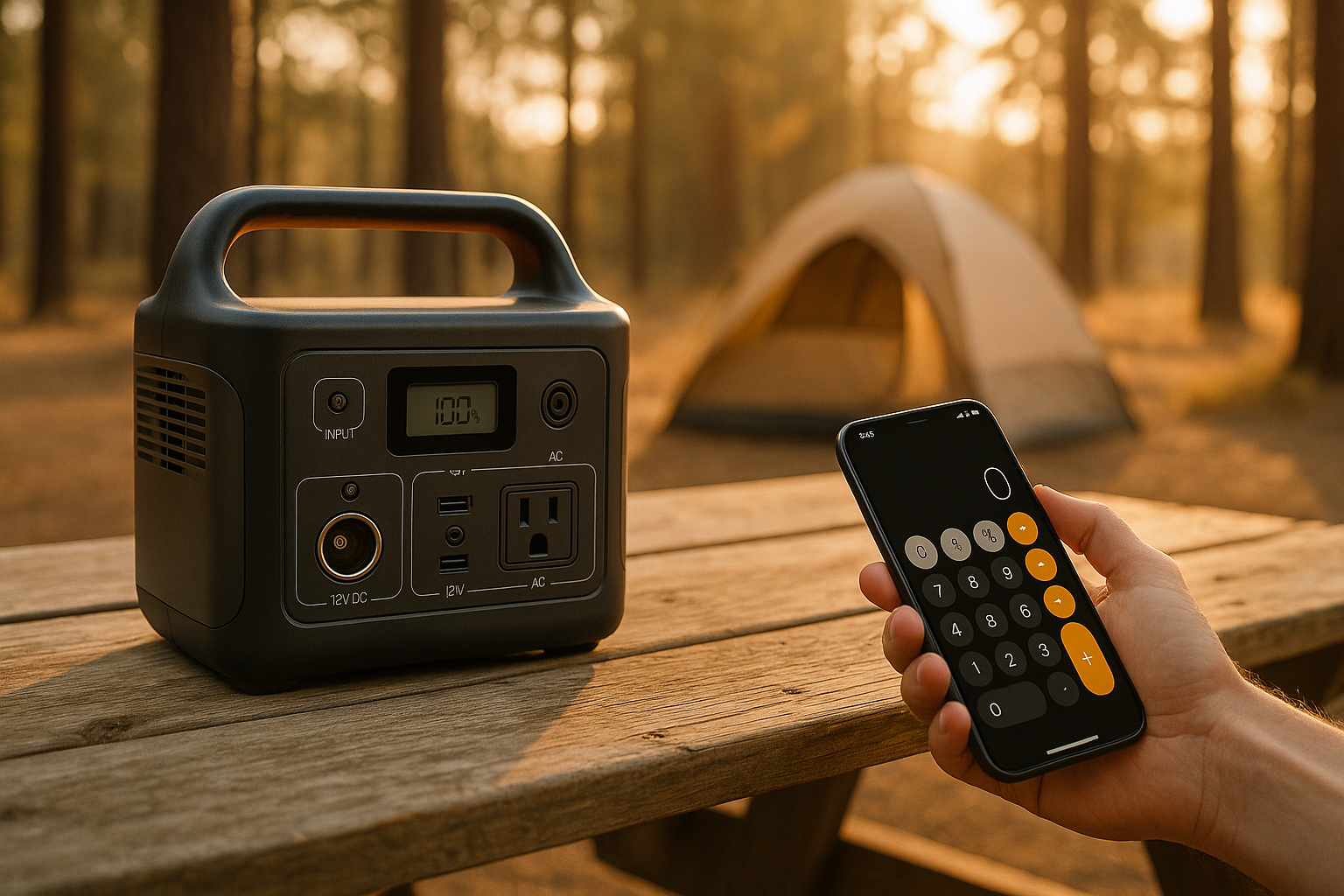
2 phones × 15Wh = 30Wh
Lantern, 4 hours × 7W = 28Wh
Fan, 6 hours × 10W = 60Wh
CPAP, 7 hours × 40W = 280Wh
Total: ~400Wh/day
Now compare that to a 256Wh unit. After accounting for inverter efficiency (roughly 85% on AC loads), you have closer to ~218Wh of usable output. Here’s how the two nights play out:
Night one: Daytime loads (phones, fan, lantern intermittently) run ~120Wh. Then the CPAP needs 280Wh overnight. Total: ~400Wh of demand against ~218Wh usable. The unit dies roughly halfway through the CPAP run — call it 3–4 hours in.
Day two: A 100W panel in good sun realistically outputs 60–80W. Over 5–6 productive hours, you recover ~300–450Wh of input, which the unit stores as roughly 255–380Wh usable. Enough to cover night two only if conditions cooperate.
Night two: Best case, you make it. Cloudy day or bad panel angle and you’re short by 100Wh+.
That’s why a 256Wh unit is tight-but-workable for this scenario only with solar recharge. Drop the CPAP and the same unit easily covers three nights with no solar at all. Add a CPAP and want margin? Step up to a 500Wh+ unit. Build around your actual load, not the marketing copy.
FAQ
How does the warranty claim process actually work on these brands?
For Anker, Jackery, Bluetti, and EcoFlow, you file directly with the manufacturer (not Amazon) using your order number and a short description of the fault — photos or a video usually help. Anker and Jackery typically respond within 1–2 business days and ship a replacement after confirming the issue. Bluetti and EcoFlow sometimes ask you to run a diagnostic (hold specific buttons, report the display readout) before authorizing a return. Keep your purchase receipt; warranty starts from purchase date, not manufacture date.
Can I run a portable AC unit off the cheapest tier?
No. Portable ACs draw 400–1,400W continuous, which is well above the 200–600W inverters on sub-300Wh units, and they’d drain the battery in 15–30 minutes anyway. Running an AC needs a 1,000Wh+ unit with a 1,500W+ inverter, which is a completely different price bracket. A 12V evaporative cooler or a USB fan is the realistic option at this tier.
Can I charge the power station and use it at the same time (pass-through)?
Yes, all four picks support pass-through charging from AC and solar. Manufacturers note that frequent pass-through use can slightly increase battery wear, but it’s fine for occasional camping use.
Can I fly with one of these?
No. All four exceed the 100Wh FAA limit for carry-on lithium batteries. They have to travel by car. Sub-100Wh power banks are a separate category.
Do I need an MPPT charge controller?
The unit has one built in. You don’t buy a separate controller —