Solar Generator Charging Time: How Fast Do They Recharge?

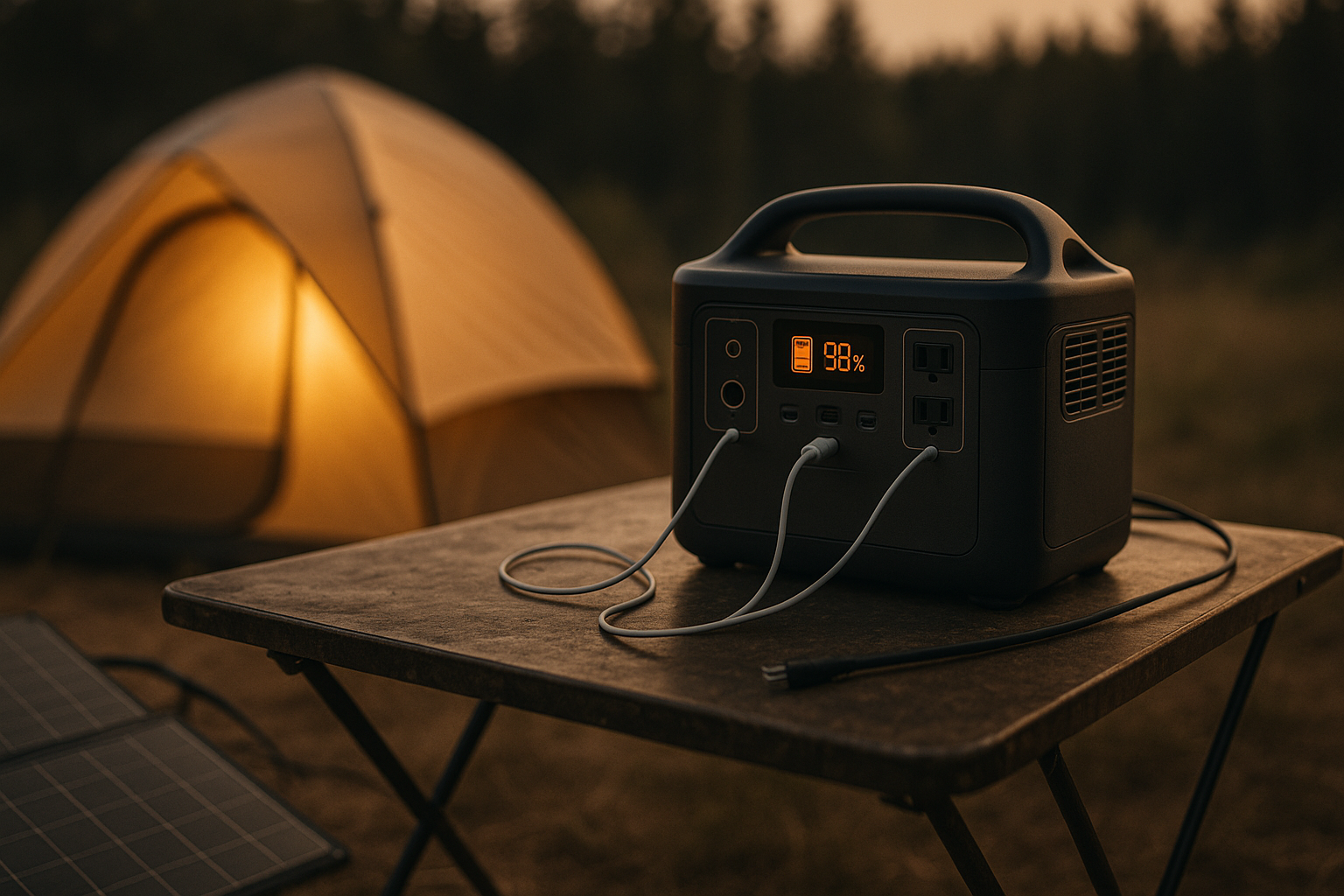
Photo by Jackery Power Station on Unsplash
Solar Generator Charging Time: How Fast Do They Really Recharge?
AC charging is 5-10x faster than 12V car input, but real-world solar times run 30-50% slower than panel ratings suggest. The marketing says “fully recharged in 1 hour” — then you plug into solar in actual daylight and it’s an eight-hour project. Here’s what to expect from AC wall, 12V car, and solar input across the budget, mid, and premium tiers, plus the variables that quietly stretch every advertised number.
The three charging inputs, ranked by speed
Every modern solar generator accepts at least three input types. They are not close to equal.
- AC wall outlet — fastest, and the figure most brands lead with in marketing.
- Solar panel input — second-fastest in ideal conditions, but heavily dependent on weather, panel size, and angle.
- 12V car/cigarette port — slowest by a wide margin; useful only as a trickle top-up while driving.
Per the manufacturer spec sheets for the major brands (EcoFlow, Bluetti, Jackery, Anker), AC charging is typically 5-10x faster than the 12V car port. Solar sits in the middle but is the most variable.
AC wall charging: what the “1 hour” claims actually mean
Premium-tier units from EcoFlow’s Delta line and Anker’s SOLIX F-series advertise full recharges in roughly an hour. Those numbers are real — under specific conditions:
- Turbo or X-Stream mode enabled (often off by default to protect battery longevity).
- Cool ambient temperature (around 20-25°C / 68-77°F).
- Battery starting from a low but not empty state of charge, typically around 5-10%.
- Wall circuit delivering its full rated amperage without voltage sag.
Per aggregated owner reports, real-world AC charging on a standard 15A household circuit tends to run 10-30% slower than the marketed best-case, especially as the unit approaches 80% — most battery management systems taper aggressively in the final stretch to extend cell life. That tapering behavior is also why fast-charge mode is recommended for occasional use rather than every cycle.
Budget-tier units (Jackery Explorer 300/500, smaller Anker models) skip fast-charge entirely. Expect 4-7 hours on AC for a full top-up, per the manufacturer spec sheets.
Solar charging: where the math gets honest
Solar input is where buyers get most disappointed, because the math is unforgiving and the marketing usually quotes peak panel output rather than realistic daily yield.
The simple formula
Roughly: battery capacity (Wh) ÷ realistic panel output (W) = solar hours to full charge.
A 1000Wh power station paired with a 200W panel does not charge in 5 hours. In peak summer sun, mid-day, panel angled correctly, with no clouds, you might hit 160-180W actual output. Add typical conditions — morning/evening sun angles, partial cloud, panel laid flat on the ground instead of tilted — and average yield drops to 90-130W. That same 1000Wh station now needs 8-11 hours of usable daylight.
What kills solar input speed
- Flat-laid panels. Per teardown reviews and YouTube field tests, laying a panel flat versus angling it toward the sun typically costs 20-40% of output.
- Heat. Solar panels lose efficiency as they get hot. A panel baking on a summer afternoon may produce less than the same panel in cool morning sun.
- Cable losses. Long extensions from panel to station drop voltage and clip output.
- MPPT input ceiling. Every station has a maximum solar input wattage. Plug in 400W of panels on a station capped at 200W solar input and you’re capped at 200W regardless.
12V car charging: the slow lane
The cigarette-lighter port on most vehicles tops out around 100-120W of usable output. For a sub-500Wh budget station this gets you a full charge over a long drive. For anything above 1000Wh, car charging is essentially a maintenance trickle — useful for keeping a partial charge from draining, not for filling an empty unit.
Per aggregated owner reports, full car-port charge times typically run 8-14 hours for mid-tier units. If you’re road-tripping with a power station, a 12V-to-XT60 cable into a higher-amperage port (where supported) is meaningfully faster — but check the manual first; not every station accepts higher 12V input.
Tier comparison: what to expect by price bracket
All figures are AC fast-charge to ~80%, per current manufacturer spec sheets.
- Budget tier (under 500Wh): 4-8 hours AC, no fast-charge. Solar input usually capped at 60-100W. Representative models: Jackery Explorer 300 (~4.5 hrs AC), Anker 521 (~5 hrs AC), Jackery Explorer 240 v2 (~3.5 hrs AC). Best for occasional weekend use.
- Mid tier (500-1500Wh): 1-1.5 hours AC to 80% with fast-charge, 3-5 hours standard mode. Solar input typically 200-500W. Representative models: EcoFlow Delta 2 (80% in 52 min AC, ~6-8 hrs with a 200W panel in full sun), Bluetti AC180 (~45 min to 80% AC, 500W max solar), Jackery Explorer 1000 v2 (~60 min AC to 80%, ~6.5 hrs with 200W solar).
- Premium tier (1500Wh+): 60-90 minutes AC fast-charge, 1000W+ solar input on flagship models. Representative models: EcoFlow Delta Pro (~2.7 hrs full AC, up to 1600W solar), Bluetti AC200L (~50 min to 80% AC, 1200W max solar), Anker SOLIX F2000 (~1 hr full AC, 1000W max solar). Built for off-grid living and whole-house backup.
For mid-tier picks specifically sized for camping, our Best Portable Power Station for Camping Under $1000 in 2026 breaks down the charging specs alongside capacity and runtime.
Top picks across the charging-speed spectrum
The fastest charger isn’t always the right buy. Here are units worth considering based on how you’ll actually recharge.
- Best for a weekend cabin trip where you need to top up overnight from a wall outlet: EcoFlow Delta 2 — hits 80% in 52 minutes on AC per the manufacturer spec, full charge in ~80 minutes, and accepts solar simultaneously with AC.
- Best if you have 400W+ of solar panels available and want to fill the station in a single day: Bluetti AC200L — 1200W max solar input, ~2 hours from empty to full in strong sun with a 1000W array, per manufacturer spec.
- Best for powering a fridge + laptop on a 3-day off-grid camping trip with mixed AC and solar recharge: Anker SOLIX F2000 — full AC in ~60 minutes, 1000W solar ceiling, ~2.5 hours full solar with a 1000W array per spec.
- Best for someone who recharges almost exclusively from a home wall outlet between trips: Jackery Explorer 1000 v2 — 60 minutes to 80% AC, ~1.7 hours full AC per spec; slower than premium tier but solid and well-supported.
- Best for a single-night backpacking or kayak trip with one 100W foldable panel: EcoFlow River 2 Max — full AC in ~60 minutes; tops up from a 110W panel in ~5-6 hours of sun per manufacturer spec.
Specific runtime sizing (capacity for fridges, CPAPs, etc.) is a separate question — covered in How to Choose a Portable Power Station: Wattage, Capacity & Runtime Explained.
Variables that quietly stretch every advertised time
Even with the right unit, these factors push real charge times past the brochure number:
- Battery chemistry. LiFePO4 (LFP) cells, now standard in most mid- and premium-tier units, charge slightly slower than older NMC cells but last 3-5x longer per cycle-life testing referenced in most current spec sheets. The trade-off is worth it.
- State of charge curve. The last 20% always charges slower than the first 80%. Plan around 80%, not 100%, if you’re rushing.
- Ambient temperature. Below ~10°C (50°F) and above ~35°C (95°F), most BMS systems throttle charge rate to protect the cells. Cold-weather solar charging is especially painful.
- Pass-through charging. Running loads while charging slows net input. If you’re powering a fridge off the station while it charges from solar, the fridge eats some of that incoming wattage.
- Cable and connector quality. Cheap aftermarket solar cables and undersized XT60 leads cost real watts.
For more on how these factors affect long-term battery health, see Portable Power Station Lifespan: Battery Degradation & Longevity Tips.
FAQ
Can I use a 400W solar panel on a station with a 200W input cap? Yes, but you’ll only ever see 200W maximum at the station. The MPPT controller clips input at its rated ceiling — the extra panel wattage is wasted. Also check the panel’s open-circuit voltage (Voc) against the station’s max input voltage; exceeding voltage limits can damage the MPPT, while exceeding wattage at correct voltage is harmless but pointless.
What’s the difference between MPPT and PWM solar controllers? MPPT (Maximum Power Point Tracking) controllers continuously adjust to extract the most power from the panel under changing light conditions, typically 20-30% more efficient than PWM (Pulse Width Modulation). Every modern solar generator from the major brands uses MPPT. PWM still shows up in cheap no-name units and is a reason to avoid them.
Can I charge from AC and solar simultaneously to cut charge time? On units that support dual input — most mid- and premium-tier models do — yes. The station combines both sources up to its internal charging ceiling. Check the spec sheet for the combined input limit; on some units the combined cap is lower than AC + solar added separately.
Will using a generator (gas or inverter) to charge my power station work? Yes, through the AC input, and it’s a common backup strategy. Use an inverter generator rather than a conventional one — the cleaner sine wave avoids triggering the station’s input protection. Match the generator’s continuous output to at least the station’s AC input draw, or charging will throttle.
Does charging speed degrade as the unit ages? Mildly. After 1000+ cycles, internal resistance rises and the BMS may reduce peak input rate slightly to protect aging cells. Most owners don’t notice it until well past the warranty period; LFP units in particular hold near-original charge speeds for years.
The honest summary
Marketed charging times are best-case lab numbers. Real-world AC charging usually runs 10-30% slower than advertised; solar charging runs 30-50% slower than the panel’s nameplate rating suggests; and 12V car charging is a trickle, not a refill. Pick a unit whose realistic AC time fits your turnaround needs, whose solar input ceiling matches the panels you actually own (or plan to buy), and whose battery chemistry favors the cycle life you want. The fastest charger on paper is rarely the best long-term buy — and pairing the right panel to the right station matters more than chasing the lowest hour count on the box.