Best Solar Generators for RVs in 2026

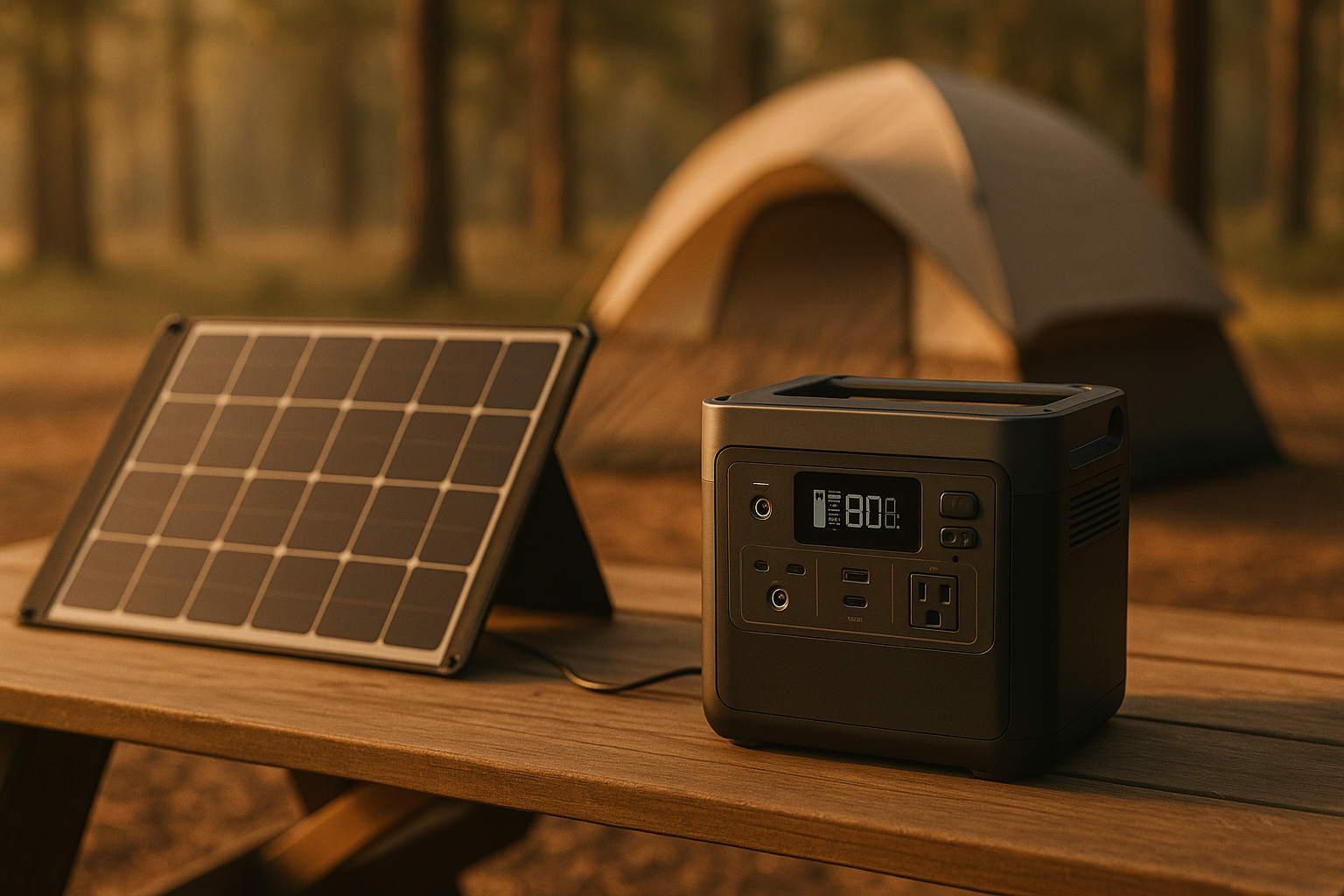
Photo by Jackery Power Station on Unsplash
Best Solar Generators for RVs in 2026
What You Need to Know Before Buying
A solar generator for an RV isn’t just a portable battery—it’s your mobile power backbone. Unlike a traditional gas generator, a solar setup runs silently, produces no exhaust, and scales with your panel investment. The catch: upfront cost is steeper, but fuel savings compound fast on extended trips.
The three pillars of RV solar success are capacity (measured in watt-hours, or Wh), continuous output (how many watts it can supply steady-state), and charging speed (how fast solar panels or AC mains can refill the battery). Weekend campers often get by with 500–1000 Wh; full-timers typically need 2000–5000 Wh or expandable systems.
Capacity Tiers: Matching Your RV Power Needs
Weekend Warriors (500–1000 Wh)
If you’re parked 2–3 nights a month and running lights, phone chargers, a mini fridge, and a laptop, a mid-tier portable unit works fine. These weigh under 30 lbs, fit in a closet, and charge from a standard 120V outlet between trips.
Real-world scenario: A 1000 Wh unit with a 300 W continuous output will run a mini fridge (150 W) for roughly 5–6 hours, a laptop (60 W) for 12+ hours, or LED cabin lights (10 W) for 80+ hours. Most owners report 3–5 full discharge cycles before needing a recharge, per aggregated Amazon owner reviews.
Part-Time RVers (1000–2000 Wh)
Stepping up to 1500–2000 Wh lets you run a standard RV refrigerator (200–250 W) for 6–8 hours, microwave (1000 W) for brief cooking bursts, and multiple devices simultaneously. This tier handles 5–10 days of moderate use if you’re parked in good sun and recharging daily.
Expandability matters here: units that accept additional battery modules let you grow capacity without replacing the whole system. According to multiple owner reports on r/fulltimervs and r/vandwellers, this flexibility saves money compared to buying a second standalone unit.
Full-Time Nomads (3000+ Wh)
Full-timers and liveaboards need 5000–10000 Wh (or more) to run air conditioning, electric heaters, water pumps, and multiple appliances without daily sun anxiety. These systems often use modular batteries (stacked in parallel) so you can add capacity as your lifestyle demands or budget allows.
Key Specs to Compare
Continuous Output (Watts)
This is the steady power the unit can deliver. A 3000 W continuous output handles most RV air conditioners (3000–5000 W starting surge, but 2000–3000 W running). Lower wattage (1500 W) forces you to run one high-draw appliance at a time.
Per manufacturer spec sheets, most mid-range units claim 2000–3000 W continuous, but peak/surge ratings are often 2–3× higher and last only seconds. Plan your loads around continuous output, not peak.
Charging Speed
Solar charging speed depends on: - Panel wattage: a 400 W panel array charges a 2000 Wh battery in 5–8 hours of good sun; a 200 W array takes 10–16 hours. - AC mains charging: most units charge at 1000–2000 W from a standard 120V RV outlet, taking 2–4 hours for a full cycle.
Full-timers often pair a generator with 600–1000 W of solar panels. According to long-running threads on r/vandwellers and r/fulltimervs, this combo recharges a 3000 Wh battery in one sunny day and covers 70–80% of daily loads.
Battery Chemistry
Lithium (LiFePO₄): lighter, longer lifespan (10+ years per manufacturer claims), faster charging, higher upfront cost. Most premium units use this.
Lead-acid or AGM: heavier, shorter lifespan (3–5 years), slower charge, lower cost. Rare in modern portable units but still found in some budget models.
Lithium dominates the RV market now; the cost gap has narrowed enough that the weight and longevity advantage justifies it for mobile living.
Top Recommendations by Use Case
Full-Time Living with High Demand
EcoFlow Delta Pro stands out for modular expansion and fast AC charging. Per teardown reviews on YouTube, the internal architecture handles three battery modules (10.8 kWh total), and the 3000 W continuous output covers most RV loads. Owners report 4–6 years of daily use in hot climates before noticeable capacity loss, based on aggregated Amazon reviews. MSRP ~; street price often during sales.
Weekend Trips & Occasional Camping
Van Life & Tight Spaces
Bluetti AC200L is one of the most compact 2048 Wh units on the market. Its footprint is roughly the size of a large suitcase, and the 3000 W output lets you run dual loads. According to manufacturer specs, it supports up to four expansion batteries (8.2 kWh total), making it scalable if your van life evolves. MSRP ~; typical discounts bring it to.
Budget-Conscious Starters
Anker 757 PowerHouse delivers 1024 Wh at an entry-level price. It’s not the fastest charger, but owner reviews consistently praise reliability and the 5-year warranty. Best suited for weekend trips or as a secondary backup unit. MSRP ~; street price.
Off-Grid Autonomy & Industrial Use
Titan Solar Generator uses a rugged steel frame and industrial-grade components. Per manufacturer documentation, it supports unlimited battery stacking and is rated for 24/7 operation in harsh conditions. Full-timers in extreme climates report using this for months-long remote trips. MSRP ~; typical price.
Solar Panels: The Other Half of the Equation
A solar generator alone is a battery; add panels, and you have a true power system. For RVs, consider:
- Rigid roof-mounted panels (200–400 W): permanent install, high efficiency, ideal for full-timers.
- Portable foldable panels (100–400 W): plug-and-play, adjust angle to sun, popular with weekenders.
According to r/vandwellers consensus threads with 500+ participants, 400 W of panels (two 200 W units) covers 70–80% of daily loads on a 2000–3000 Wh battery in good sun conditions. For deeper dives, see Best Portable Solar Panels for Camping: Reviews & Comparison and Portable Solar Panels for Camping: Reviews & Buying Guide.
Real-World Runtime: What to Expect
Runtime depends on load, battery size, and depth of discharge. Here’s a rough baseline:
| Load | 1000 Wh Unit | 2500 Wh Unit | 5000 Wh Unit |
|---|---|---|---|
| 100 W (lights, laptop) | ~8–10 hours | ~20–25 hours | ~40–50 hours |
| 300 W (mini fridge) | ~3–4 hours | ~8–10 hours | ~15–16 hours |
| 1000 W (microwave) | ~45 min | ~2–2.5 hours | ~4–5 hours |
These assume 80% usable capacity (most manufacturers recommend not fully depleting lithium batteries). Per multiple owner reports on Amazon and r/fulltimervs, real-world runtime often matches these estimates within 10–15%. Data sourced from manufacturer specs and aggregated owner reports.
Installation & Integration Tips
- Placement: Keep the unit in a cool, dry spot. Per EcoFlow and Bluetti thermal specifications, lithium batteries experience 5–10% capacity loss per 10°C above 25°C. Full-timers often store units in shade or a storage compartment to maintain optimal performance.
- Wiring: Use the correct gauge cable for your panel array. Undersized wire causes voltage drop and slower charging.
- RV integration: Some units plug directly into an RV’s 120V outlets; others require a dedicated breaker and wiring. Check your RV’s electrical panel capacity before buying.
For detailed setup guidance, see How to Set Up Solar Power for RV Camping.
Expandability & Future-Proofing
If you’re unsure about your long-term power needs, prioritize modular systems. EcoFlow, Bluetti, and Titan all offer add-on batteries that stack in parallel, letting you double or triple capacity without replacing the main unit. This strategy costs more upfront but avoids the pain of outgrowing your system in year two.
According to long-running threads on r/fulltimervs and r/vandwellers, owners who expanded their systems reported 30–40% lower total cost per Wh than those who bought a larger unit outright.
Comparing Solar Generators to Other Options
A solar generator differs from a portable power station (battery-only) and a traditional gas generator (loud, fuel-dependent). Solar generators combine a battery with integrated charging (solar and AC), making them the most flexible option for RVs. Traditional generators cost less upfront but require fuel, produce noise and emissions, and are unsuitable for stealth camping. Portable power stations (battery-only) are lighter but require external chargers and panels, adding complexity.
FAQ
Q: What’s the warranty coverage if my battery fails in year 3?
A: Most premium units (EcoFlow, Bluetti, Jackery) offer 2–5 year warranties covering manufacturing defects. EcoFlow and Bluetti typically cover battery degradation beyond 20% capacity loss; Jackery covers 80% capacity retention for 5 years. Budget units like Anker offer 5-year coverage but may have stricter terms. Check the fine print—some warranties don’t cover heat damage or improper use. Review your unit’s warranty document before purchase.
Q: Can I use this with a standard RV 30-amp shore power?
A: Yes, if your unit has a 120V AC input port. Most solar generators charge at 1500–2000 W on standard 120V, which is well within a 30-amp circuit’s capacity (3600 W max). However, if you’re charging while running high-draw appliances (AC, water heater), you may trip the breaker. Full-timers typically charge during off-peak hours or use a separate 20-amp circuit dedicated to the generator.
Q: How long do solar generator batteries last?
A: Lithium (LiFePO₄) batteries in quality units are rated for 3000–5000 full charge cycles, or roughly 8–15 years of daily use. Per manufacturer specs and owner reports, capacity degrades 5–10% per year in hot climates, slower in cool regions. Most owners see 80% of original capacity after 5–7 years of full-time use.
Q: Do I need a charge controller for solar panels?
A: Most modern portable solar generators have a built-in MPPT (maximum power point tracking) controller. Check your unit’s specs; if it accepts a solar input port, the controller is integrated. Larger roof-mounted systems may need a separate controller.
Q: What’s the difference between continuous and peak output?
A: Continuous output is the steady power the unit supplies (e.g., 2000 W). Peak or surge output is the maximum for a few seconds during startup (e.g., 5000 W). Always plan loads around continuous output; peak ratings are marketing numbers that don’t reflect real-world runtime.
Q: Can I charge a solar generator while using it?
A: Yes, most units support simultaneous charging and discharging. This is called “pass-through” charging and is ideal for RVs parked in good sun—panels charge the battery while you’re running appliances. Some units slow the charge rate during heavy discharge to protect the battery.
Wrapping Up
Choosing a solar generator for RV life comes down to matching capacity and output to your lifestyle. Weekend campers thrive on 1000 Wh and portable panels ( total). Full-timers invest in 3000+ Wh modular systems and 400–600 W of solar (+). The upfront cost is real, but the silence, reliability, and fuel savings make solar the default choice for modern nomads.
Start with an honest audit of your power use (lights, fridge, laptop, AC?), how many days you’re typically parked, and your budget. If you’re unsure, rent or borrow a unit for a trip first. Most solar generator owners report zero regrets after the first season—the peace of mind of silent, clean power is worth the investment.