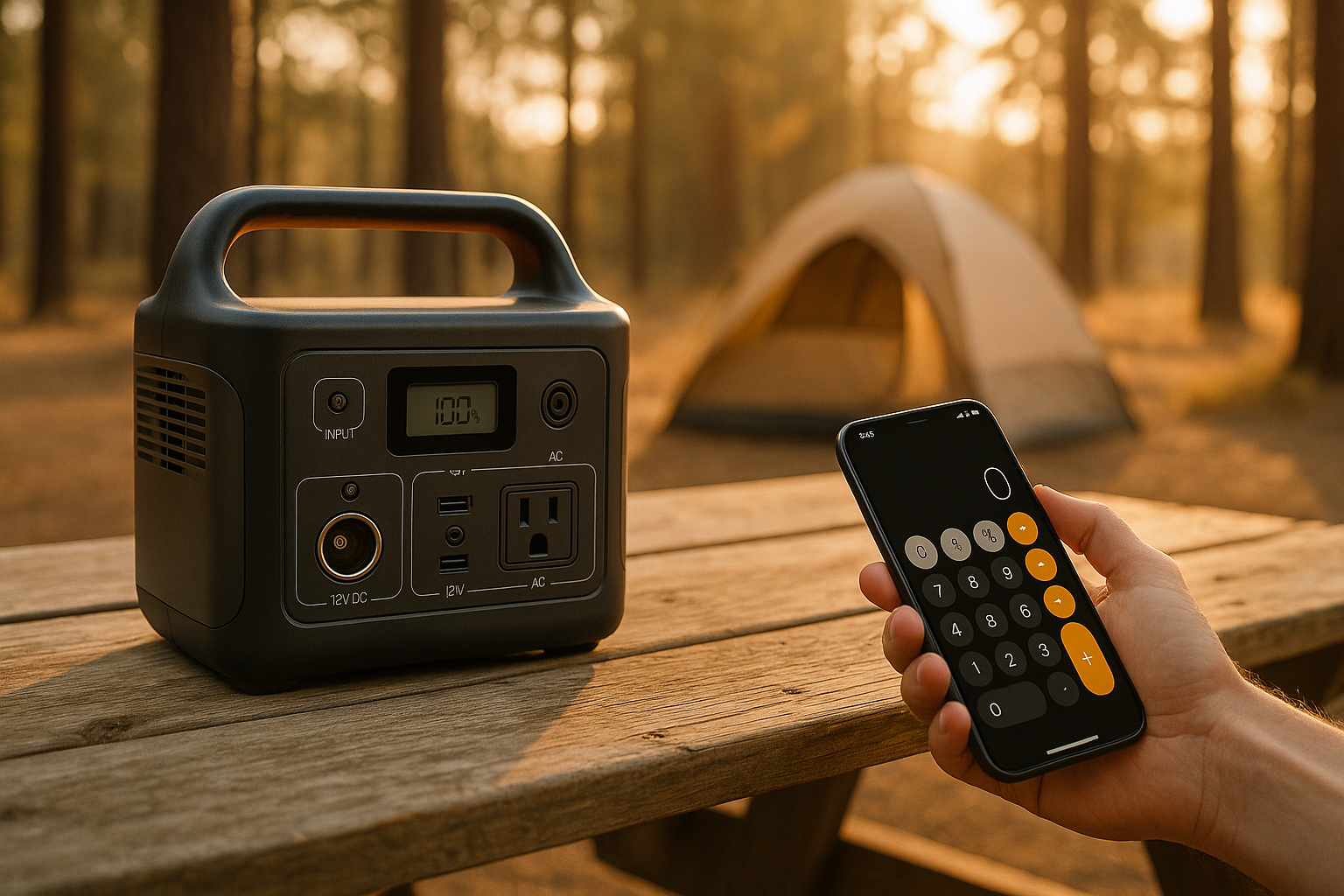
How Long Does a Portable Power Station Last? Runtime & Capacity Guide

Photo by Jackery Power Station on Unsplash
How Long Does a Portable Power Station Last? Runtime & Capacity Guide
Runtime on a portable power station depends on battery capacity, the wattage of devices you’re running, and how efficiently the inverter converts DC to AC power. A 1000Wh unit powering a 100W load will theoretically run for 10 hours; running a 500W microwave drains it in 2 hours. But real-world numbers are messier: inverter losses, battery degradation, and cold temperatures all eat into that math. This guide walks you through the actual calculations, the factors that shorten lifespan, and how to squeeze every hour out of your station.
Runtime: The Math Behind Battery Capacity and Wattage
Portable power stations advertise capacity in watt-hours (Wh), which is the foundation of runtime math. A 500Wh unit stores 500 watts of power for one hour—or 250 watts for two hours, or 1000 watts for 30 minutes. The formula is simple:
Runtime (hours) = Battery Capacity (Wh) ÷ Device Wattage (W)
A Bluetti AC70P with 768Wh powering a 100W laptop will theoretically last 7.68 hours. But that’s theoretical. Real-world runtime is typically 10–20% shorter due to inverter inefficiency (the electronics that convert stored DC power to AC power your devices use). Most quality units achieve 85–95% inverter efficiency, meaning you lose 5–15% of stored energy in the conversion process.
Example: A 1000Wh station with a 90% efficient inverter actually delivers about 900Wh of usable power. Running a 200W coffee maker: 900Wh ÷ 200W = 4.5 hours, not the advertised 5 hours.
Manufacturers sometimes list usable capacity (what you actually get) versus total capacity (the raw battery size). Always check the spec sheet. Premium units like the EcoFlow Delta Pro are transparent about both; budget models sometimes hide the gap.
Battery Degradation: How Long Until Runtime Drops?
Portable power stations use lithium-ion or lithium iron phosphate (LiFePO₄) batteries. Both degrade over time—that’s chemistry, not a defect.
Lithium-ion batteries (found in most mid-tier units) are rated by manufacturers for 500–1000 full charge cycles before dropping to 80% capacity. At one cycle per week, that’s 10–20 years of theoretical life. In practice, owners report noticeable runtime drops (10–15%) after 3–5 years of heavy use (daily charging and discharge), particularly in hot climates.
Lithium iron phosphate (LiFePO₄) batteries (premium units like 
Factors that accelerate degradation:
- Heat exposure: Storing a power station in direct sunlight or a hot vehicle can degrade the battery 2–3× faster than cool storage. Keep it between 50–80°F when not in use.
- Deep discharges: Draining a unit to 0% and leaving it there for weeks stresses the battery. Recharge to at least 20% after each use.
- Overcharging: Leaving a station plugged in 24/7 after reaching full charge degrades capacity. Most modern units auto-stop charging, but older models don’t.
- Cold weather: Below 32°F, lithium batteries lose 20–30% of their output capacity temporarily. Warm the unit before heavy use in winter.
Real-World Runtime: What Devices Actually Consume
Advertised capacity means little without knowing what you’re powering. Here’s what typical devices draw:
| Device | Typical Wattage | Runtime on 1000Wh Unit |
|---|---|---|
| Smartphone charging | 10–20W | 50–100 hours |
| Laptop (MacBook Air) | 50–100W | 10–20 hours |
| LED camping light | 5–10W | 100–200 hours |
| Mini-fridge | 60–150W continuous | 7–17 hours |
| Microwave (1000W) | 1000W continuous | ~1 hour |
| CPAP machine | 60–100W | 10–17 hours |
| Portable projector | 100–150W | 7–10 hours |
| Air compressor | 300–500W continuous | 2–3 hours |
Note on wattages: Continuous wattage figures are based on Energy Star ratings and manufacturer spec sheets. Peak or startup wattage (inrush current) is typically 20–50% higher and lasts only seconds; most devices then settle into lower continuous draw. A microwave marked “1000W” draws that continuously while running; a mini-fridge cycles on and off, averaging 60–150W over time.
Many devices have misleading marketing wattages. A “500W” space heater actually draws 1500W on high; a “quiet” portable AC unit pulls 800W+ running. Always check the device’s spec label or use a Kill-A-Watt meter before assuming advertised wattage.
How to Extend Runtime in the Field
Once you’ve got a power station, a few habits maximize usable hours:
-
Prioritize low-draw devices first. Charge phones and lights before running high-wattage appliances. You’ll get more total utility from the battery.
-
Use DC ports when possible. Running a device directly on 12V DC (car-style) bypasses the inverter and loses only 2–5% to conversion, versus 10–15% through AC. Most units have USB and 12V ports; use them for phones, fans, and lights.
-
Charge during peak sun (if solar-equipped). If you’re pairing your station with solar panels, recharge during midday when panel output is highest. See Portable Solar Panels for Camping: Reviews & Buyer's Guide 2026 for panel matching.
-
Avoid cold-weather discharge. Below 32°F, battery output drops sharply. Keep the unit indoors or insulated if you’re using it in winter camping.
-
Top up regularly. Don’t let the battery sit at 0% for weeks. A monthly 20% recharge keeps the chemistry healthy.
-
Pair with solar for continuous use. A Bluetti AC70P with a 200W solar panel recharges in 4–6 hours of direct sunlight, enabling 2–3 full cycles per day for sustained off-grid operation.
Comparing Lifespan Across Capacity Tiers
Different capacity classes suit different use cases and have different practical lifespans:
Budget-tier (256–500Wh): Best for weekend trips or phone/light backup. Expect 3–5 years of reliable daily use before noticeable capacity loss. Ideal if you’re camping 4–8 times per year.
Mid-tier (750–1500Wh): The sweet spot for RV life, off-grid cabins, and frequent camping. With moderate use (2–3 charge cycles per week), most owners report 5–7 years before hitting 80% capacity. Premium mid-tier units with LiFePO₄ chemistry stretch to 8–10 years.
Premium-tier (2000Wh+): Designed for continuous or near-continuous use. LiFePO₄ units like the EcoFlow Delta Pro are rated for 10+ years of daily cycling. Total cost of ownership is lower than replacing a budget unit twice.
Capacity Calculator: Sizing for Your Needs
To pick the right capacity, estimate your daily wattage needs:
- List devices you’ll run and their wattages (check the spec label or manual).
- Estimate daily hours for each. Will you run a 100W mini-fridge 16 hours? A 50W laptop 8 hours?
- Multiply and sum: 100W × 16h = 1600Wh; 50W × 8h = 400Wh. Total: 2000Wh needed.
- Add 20% buffer for inverter losses and battery degradation: 2000 × 1.2 = 2400Wh recommended.
Worked example: Running a Nespresso machine (1500W for 5 minutes) + MacBook (60W for 8 hours) requires: (1500W × 0.083h) + (60W × 8h) = 125Wh + 480Wh = 605Wh. With a 20% buffer: 605 × 1.2 = 726Wh minimum. A 768Wh Bluetti AC70P handles this comfortably.
Seasonal and Environmental Effects on Runtime
Temperature and humidity aren’t just comfort factors—they directly affect how long your station lasts on a charge.
Summer heat (85°F+): Lithium batteries perform at rated capacity but degrade faster. A unit left in a hot car loses 5–10% of its lifespan per summer season. Store indoors or in shade.
Winter cold (below 32°F): Temporary capacity loss of 20–30%. A 1000Wh unit might deliver only 700–800Wh of usable power. The capacity returns when warmed, but repeated cold cycles accelerate long-term degradation. If you’re winter camping, insulate your station or keep it inside your tent.
High humidity (>80%): Doesn’t directly affect runtime, but moisture can corrode terminals over time. Ensure your unit has proper ventilation and avoid storing it in damp basements or garages.
High altitude (8000+ feet): Air is thinner, so cooling is less efficient. Power stations may thermal-throttle (reduce output) if they overheat. Keep vents clear and avoid sustained high-wattage draws at altitude.
FAQ
Q: Can I use a portable power station while it’s charging?
A: Yes. Most modern units support pass-through charging—you can run devices and recharge simultaneously. However, charging speed slows when the unit is under load. For example, a EcoFlow Delta Pro charging at 1000W while powering a 500W device will charge at roughly 500W net. Check your unit’s manual for pass-through specifications.
Q: What’s the difference between Wh and Ah?
A: Wh (watt-hours) is energy capacity; Ah (amp-hours) is charge capacity. They’re related by voltage: Wh = Ah × Voltage. A 1000Wh station at 48V = 20.8Ah. Wh is more useful for calculating runtime because it directly relates to wattage: Runtime = Wh ÷ Watts. Ah is useful for solar charging calculations (amps × hours = Ah).
Q: How often should I charge my portable power station if I’m not using it?
A: Once every 3–6 months, charge to 50–80% for storage. Lithium batteries self-discharge slowly (1–2% per month), and letting them sit at 0% for months accelerates degradation. A simple calendar reminder works fine.
Q: Does using solar to recharge affect battery lifespan differently than wall power?
A: No. The charge rate (amps per hour) matters more than the source. Slow solar charging (50–100W) is gentler on the battery than fast AC wall charging (1000W+). If you’re pairing with solar, you’ll actually extend lifespan slightly due to slower charge cycles.
Q: Can I replace the battery in my power station?
A: Some premium units (like the EcoFlow Delta Pro) support modular battery expansion, but full battery replacement is rarely offered by manufacturers. It’s usually cheaper to buy a new unit. Check the warranty—most cover battery degradation for 2–5 years.
Summary
A portable power station’s runtime depends on capacity (measured in watt-hours) and the wattage of devices you’re running. A 1000Wh unit powering a 100W device lasts roughly 10 hours, minus 10–15% for inverter losses. Real lifespan—before noticeable capacity drop—ranges from 3–5 years for budget lithium-ion units to 8–10+ years for premium LiFePO₄ models, assuming moderate use and proper storage.
Temperature, charge cycles, and how deeply you discharge the battery all affect how quickly it degrades. Keeping your station cool, avoiding deep discharges, and matching capacity to your actual needs will maximize both runtime per charge and total years of service. For frequent off-grid users, pairing a power station with solar panels enables sustained cycles: a 200W solar panel recharges a 1000Wh station in 5–6 hours of peak sunlight, enabling 2–3 full cycles per day. See Best Solar Generators for Off-Grid Living: Complete Setup Guide 2026 for full system design.