Portable Power Station for Camping: Capacity & Features Explained
Portable Power Station for Camping: Capacity & Features Explained
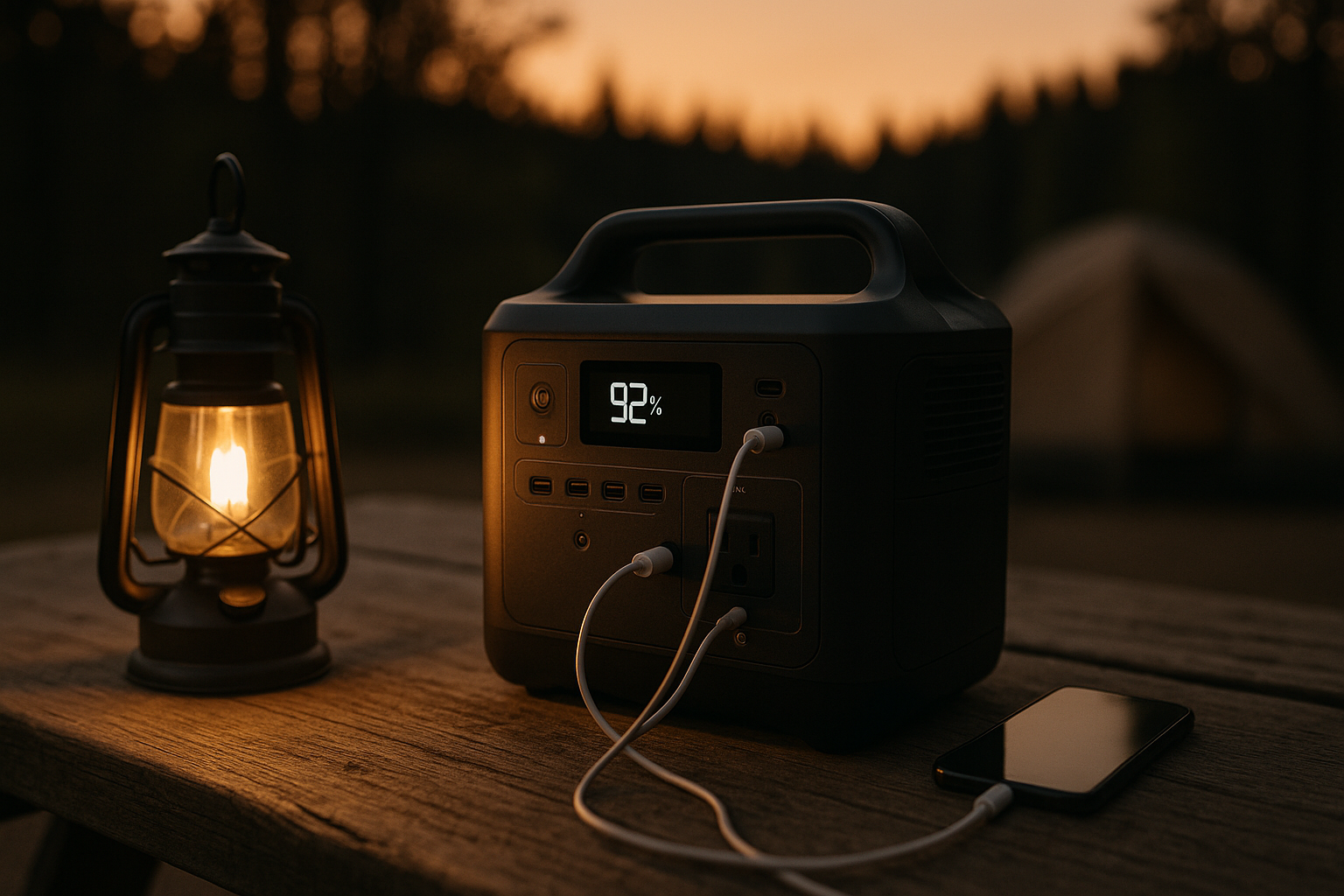
A 500 Wh portable power station runs your phone, camping fan, and cooler for a full weekend without a car outlet or gas generator. It’s a battery pack with AC outlets, USB ports, and DC connectors that lets you charge devices, run a camping fan, or power a small refrigerator at a remote site. This guide walks you through the specs that actually matter: capacity, wattage, runtime, and charging options.
Understanding Capacity: Wh vs. mAh
Portable power stations list capacity in watt-hours (Wh), which directly tells you how long a device will run. A 1000 Wh station can theoretically run a 100 W device for 10 hours (before accounting for inverter losses, which typically reduce usable output by 10–15%).
Why not milliamp-hours (mAh)? mAh is voltage-dependent and requires math to convert to real-world runtime. Wh is the standard for power stations because it’s directly comparable across brands and doesn’t hide the voltage. When shopping, always look for the Wh number prominently displayed—usually on the product spec sheet or manual.
Capacity tiers for camping
- 100–300 Wh: Phone charging, small LED lights, USB devices. Good for car camping near a charging outlet or as backup. Examples: Anker 521 (256 Wh), Jackery Explorer 240 (240 Wh).
- 500–1000 Wh: The sweet spot for most camping trips. Runs a camping cooler, charges multiple devices, or powers a small fan for 8–12 hours depending on load. Examples: Anker 757 (768 Wh), EcoFlow River 2 (512 Wh).
- 1500–3000 Wh: Longer trips, multiple people, or power-hungry gear (e.g., a CPAP machine). Overkill for a weekend unless you’re running AC appliances. Examples: Jackery Explorer 2000 Pro (2160 Wh), EcoFlow Delta 2 (1024 Wh).
- 5000+ Wh: Semi-permanent off-grid setups, RV living, or powering a full-size refrigerator. Rarely needed for traditional camping.
Peak vs. Continuous Wattage
Every power station lists two wattage numbers:
- Continuous (rated) wattage: The maximum steady power it can supply. A 1000 W continuous rating means you can safely run a device that draws 1000 W all day.
- Peak (surge) wattage: A brief power spike it can handle—usually 2–3× the continuous rating. Induction motors (like a fan or compressor) draw extra current when starting. Peak wattage lets the station survive that spike without shutting down.
For camping: Most loads are low-surge (LED lights, USB chargers, laptops). A camping cooler or small fan is moderate-surge. Check the peak rating if you plan to run anything with a motor. If the power station’s continuous rating is below your device’s draw, it will shut off to protect the battery.
Runtime: The Real-World Math
Runtime depends on three factors:
- Battery capacity (Wh)
- Device power draw (W)
- Inverter efficiency (typically 85–90% for AC outlets)
Quick formula: (Capacity × Efficiency) ÷ Device Wattage = Runtime in hours
Example: A 1000 Wh station (85% efficient) powering a 100 W camping light: (1000 × 0.85) ÷ 100 = 8.5 hours
USB ports draw power directly from the battery without inverter loss, so they’re slightly more efficient. AC outlets go through an inverter, which costs a few percentage points.
Real-world camping scenario: If you’re running a mix of devices—a phone charger (10 W), a camping fan (50 W), and an LED lantern (5 W)—total draw is 65 W. A 500 Wh station would run all three for roughly 6–7 hours before depleting. Recharge via car outlet (12V DC input), wall plug, or solar panels during the day.
Charging Methods: Speed and Flexibility
How fast you recharge matters, especially on multi-day trips.
Wall outlet (AC input)
- Speed: 1–4 hours depending on charger wattage (most units ship with 60–100 W chargers).
- Use case: Home prep before a trip, or at a campground with electrical hookups.
- Note: Check the input wattage on the spec sheet; higher wattage = faster recharge.
Car 12V outlet (DC input)
- Speed: 8–24 hours for a full recharge (very slow).
- Use case: Emergency top-up during a road trip, or as a fallback.
- Advantage: Works anywhere you have a car.
Solar panels
- Speed: Depends on panel wattage and sunlight. A 100 W solar panel recharges a 500 Wh station in roughly 5–8 hours on a clear day, per manufacturer testing.
- Use case: Multi-day trips without access to wall power.
- Reality check: Solar is slower than AC and weather-dependent. It’s a supplement, not a primary recharge method for most camping trips.
For camping, a high-wattage AC charger (100 W+) is most practical if you have access to hookups. Solar is valuable as a backup on longer trips.
Port Selection: USB, AC, and DC
Different devices need different connectors. Check what you’re actually bringing to camp.
| Port Type | Devices | Notes |
|---|---|---|
| USB-A (standard) | Phones, small lights, older devices | Universal; low power (usually 2–3 A max per port). Most common on budget units. |
| USB-C | Phones, tablets, laptops | Faster charging; wattage varies widely (5 W to 100 W). Check the spec sheet—premium units support 60 W+; budget models may only offer 5–18 W. |
| AC outlets (120V) | Fans, laptop chargers, small appliances | Inverter-based; slightly less efficient; limited quantity. Standard on premium units; fewer on budget models. |
| DC 12V output | Car accessories, portable coolers, lights | Efficient; direct battery draw; useful for RV-style gear. More common on premium units. |
| Wireless charging | Some phones | Rare on power stations; not essential for camping. |
For camping: Most people need at least two USB ports (one per person) and one AC outlet for a laptop or fan. Count your devices before buying. A station with only USB ports can’t run a camping cooler or fan; one with only AC outlets is overkill for phones. When choosing USB-C, verify the wattage supports your charger (check your charger’s label for “W” or “A” rating).
Weight, Size, and Portability
Capacity and weight scale together. A 500 Wh unit weighs 10–15 lbs; a 2000 Wh unit weighs 40–60 lbs.
- Ultralight (under 5 lbs): 100–200 Wh. Phone charging only; good for backpacking.
- Portable (10–20 lbs): 500–1000 Wh. Car camping sweet spot; fits in a backpack or car trunk.
- Heavy (30+ lbs): 2000+ Wh. Requires a cart or stays in the vehicle; best for base camp or RV.
If you’re hiking to camp, weight is critical. If you’re car camping, a heavier unit with more capacity is fine.
Display and Monitoring
Most modern units show: - Remaining battery percentage (0–100%) - Current input/output wattage (how much power you’re drawing or supplying) - Estimated runtime (some units calculate this automatically based on current load)
These displays help you avoid draining the battery completely and let you estimate how long you can run a specific device. Useful but not essential; older units without displays still work fine.
Safety Features
Look for: - Over-temperature protection: Shuts off if the battery overheats (important in hot climates). - Overload protection: Cuts power if you plug in a device drawing more than the rated wattage. - Low-temperature charging: Some units won’t charge below freezing; check if you’re camping in cold weather. - UPS mode (optional): Automatically switches to battery if AC input drops (useful for RV or car camping with unreliable power).
Most reputable brands include these as standard. Check reviews or the manual if you’re camping in extreme conditions.
Noise Level
Portable power stations are silent at idle (no moving parts). AC outlets produce a slight hum under load (usually inaudible), but nothing like a gas generator. This is one reason they’re preferred for camping—no noise pollution, no fumes.
Lifespan and Battery Degradation
Lithium-ion batteries (standard in portable power stations) degrade over time. Most units retain 80% capacity after 500–1000 charge cycles (roughly 2–5 years of regular use). After that, capacity drops gradually. Warranties typically cover 2–3 years; some brands offer longer coverage.
For casual camping (a few trips per year), a power station should last 5+ years before meaningful degradation. Heavy use (weekly charging) will shorten lifespan.
Comparing to Alternatives
Portable power station vs. gas generator: Generators are louder, produce fumes, and require fuel storage. Power stations are silent, clean, and ideal for car camping. Generators win on raw power and unlimited runtime (refuel and run again), but for typical camping loads, a power station is more practical.
Portable power station vs. car battery: Your car’s 12V battery can power DC accessories but won’t safely run AC appliances. A power station is designed for AC/USB mixed loads and won’t drain your car battery if you forget to turn it off.
Portable power station vs. solar generator: A “solar generator” is a power station + solar panel bundle. The power station part is identical; you’re paying extra for the panels. Buying them separately gives you flexibility if you don’t need solar immediately.
Sizing for Your Trip
Ask yourself: 1. How many days? Longer trips need larger capacity or a recharge plan. 2. What devices? List each: phones, laptop, fan, cooler. Add up wattages. 3. How many hours per day? Will you run devices continuously or just at night? 4. Recharge access? Car outlet, wall plug, or solar only?
Example: Weekend camping for two people - Devices: 2 phones (check your charger’s wattage rating; fast chargers draw 18–65 W; standard chargers draw 10–30 W), 1 laptop (60 W), 1 camping fan (50 W), 1 LED lantern (5 W) - Using moderate estimates: 2 phones at 20 W each (40 W), laptop 60 W, fan 50 W, lantern 5 W - Daily use: 4 hours (evening/night) - Total draw: 155 W average - Energy needed: 155 W × 4 hours = 620 Wh per day - Recommendation: A 500–1000 Wh unit. Recharge at night via car outlet or wall plug if available, or bring a small solar panel as backup.
Quick Picks
Choose based on your camping style:
- Best for backpacking: Anker 521 Portable Power Station (256 Wh, 3.3 lbs). Lightweight, handles phone and light charging, fits in a pack.
- Best for car camping (weekend): EcoFlow River 2 (512 Wh, 13.6 lbs). Sweet spot of capacity and weight; runs a fan and multiple devices for 8+ hours.
- Best for longer trips or groups: Anker 757 (768 Wh, 18.7 lbs). More capacity than River 2; still portable; handles a cooler and fan simultaneously.
- Best value: Jackery Explorer 240 (240 Wh, 6.6 lbs). Budget-friendly; good for short trips or as a backup unit.
FAQ
Q: What’s the difference between a portable power station and a portable solar generator? A portable solar generator is a power station bundled with solar panels. The power station itself is identical to a standalone unit. You’re paying extra for the panels. Buy them separately if you want flexibility—you might not need solar on every trip.
Q: Can I use a portable power station to charge my car battery? No. A portable power station outputs 120V AC or 12V DC at low amperage. Your car battery needs a dedicated charger with higher amperage and specific charging profiles. Attempting this will damage the power station or car battery.
Q: How long does a portable power station take to charge? Typically 2–6 hours via wall outlet (depending on charger wattage). Car 12V outlets take 12–24 hours. Solar panels depend on sunlight and panel size but usually take 6–10 hours for a medium capacity unit.
Q: Can I run a camping air conditioner on a portable power station? Most camping ACs draw 1000+ W continuously. Even a 2000 Wh unit would run for under 2 hours. Not practical unless you have a very large station (5000+ Wh) or access to wall power. Camping fans (50–100 W) are the better choice.
Q: Do I need to fully discharge a portable power station before recharging? No. Modern lithium-ion batteries have no “memory effect.” Charge whenever convenient. Partial recharges are fine and may extend overall lifespan.
Summary
A portable power station for camping is sized by capacity (Wh), continuous wattage, and your device list. Most car-camping trips are covered by a 500–1000 Wh unit with at least one AC outlet and two USB ports. Charging speed matters if you’re recharging during the trip; AC wall power is fastest. Weight and portability depend on how far you’re hiking to camp. Runtime is straightforward math: divide capacity by device wattage, accounting for inverter efficiency. Choose based on your actual trip length, devices, and recharge access—not on brand hype or unnecessary capacity.