Best Backup Power for Refrigerator During Power Outage

Photo by Jackery Power Station on Unsplash
Best Backup Power for Refrigerator During Power Outage
A power outage that lasts more than a few hours puts your refrigerator—and the food inside—at serious risk. Unlike a laptop or phone, a fridge can’t run on a small battery pack. You need a system with enough capacity to sustain its compressor for hours, and enough wattage to handle the startup surge when the motor kicks in. This guide walks you through the power math, hardware options, and real-world picks for keeping your fridge cold when the grid goes down.
How Much Power Does a Refrigerator Actually Draw?
A typical household refrigerator consumes between 600–800 watts when the compressor is running, per manufacturer nameplate specs. But here’s the catch: the compressor doesn’t run continuously. It cycles on and off throughout the day to maintain temperature. During an outage, you’re not looking at constant 600W draw; instead, you’ll see duty cycles where the compressor runs 30–50% of the time, depending on how often you open the door and how well your fridge is insulated, per U.S. Department of Energy data.
Continuous vs. surge power matters. The compressor needs a brief current spike (often 1,200–2,000 watts) to start up. A backup power system must handle both the running load and the inrush current, or it will shut down immediately.
For practical planning: assume a 700-watt running load with a 1,500-watt startup surge. If your specific fridge model is available, check its nameplate or manual—manufacturers list both running watts and peak amperage.
Calculating Runtime: The Watt-Hour Formula
To know how long a backup system will keep your fridge running, you need three numbers:
- Fridge wattage (let’s use 700W as our example)
- Duty cycle (assume 40%—the compressor runs 40% of each hour)
- Battery capacity in watt-hours (Wh)
The math: - Actual consumption per hour = 700W × 0.40 = 280 Wh/hour - A 2,048 Wh battery ÷ 280 Wh/hour = ~7.3 hours of runtime
Important note: Actual runtime varies ±20–30% based on ambient temperature, door-opening frequency, and fridge age. Warmer kitchens and frequent door openings increase the compressor’s duty cycle, reducing runtime. Older fridges may draw more power than their nameplate rating. For a personalized estimate, use a runtime calculator tool specific to your power station model (most manufacturers provide these on their websites).
This is why capacity matters: you need to read the Wh rating, not mAh. A 5,000 mAh battery is useless for a fridge; a 2,048 Wh system is practical.
Real-world caveat: Battery systems lose 5–15% efficiency when inverting DC to AC. Your actual runtime will be slightly shorter than the math suggests.
Portable Power Stations vs. Whole-Home Backup
Portable power stations (5 kWh or smaller, 50–100 lbs, ) are ideal if you: - Rent and can’t install a permanent system - Want to move the battery between rooms or properties - Need something that fits in a closet or garage - Prefer a faster, cheaper setup
Whole-home generators (natural gas or propane, 10+ kW, + installed) are better if you: - Own your home and can afford permanent installation - Want to run multiple appliances simultaneously (AC, heating, water heater) - Need unlimited runtime (as long as fuel is available) - Don’t mind ongoing maintenance and permitting
For a fridge-only scenario, a mid-tier portable power station (3–5 kWh) is usually the sweet spot. It’s affordable, doesn’t require installation, and can handle 12–24 hours of runtime depending on the model and your fridge’s duty cycle.
What to Look for in a Backup Power System
Wattage rating: Must handle at least 1,500 watts continuous output to cover the startup surge. Many budget models top out at 1,000W and will fail on a fridge.
Capacity (Wh): Aim for at least 2,000 Wh (2 kWh) for a 4–6 hour buffer, or 3,000+ Wh for overnight coverage. Per aggregated owner reviews and manufacturer specs, systems in the 2–5 kWh range are most practical for fridge-only use.
AC outlet count and quality: You want at least two standard 120V outlets. Pure sine wave inverters (not modified sine wave) are safer for sensitive electronics like refrigerator compressors.
Expandability: Some systems let you add a second battery for extended runtime without buying a whole new unit. This is valuable if you want to upgrade later without waste.
Recharge speed: A system that charges from 0–100% in under 10 hours via wall outlet is practical for frequent use. Solar recharge is a bonus if you plan for longer outages.
Noise level: Portable power stations are silent (they use inverters, not engines). Generators are loud (70–90 dB). For apartment living or noise-sensitive situations, a battery system is essential.
Top Recommendations by Scenario
Best for Short Outages (4–8 hours) with Limited Space
EcoFlow Delta 2 — As of May 2026,
The Delta 2 offers 1,024 Wh of capacity in a compact, 7 kg (15 lb) form factor. Its 1,500W continuous output handles fridge startup without strain. Per manufacturer specs and owner reports on Amazon, this system keeps a standard fridge running for 4–6 hours depending on duty cycle. It charges fully in about 1 hour from a wall outlet, making it practical for frequent top-ups. Best for apartments or small homes where floor space is tight.
Best for Extended Outages (24+ hours) on a Budget
Anker 757 PowerHouse — As of May 2026,
At 1,229 Wh, the Anker 757 sits in the mid-tier price range while offering solid capacity. Its 1,500W continuous output is sufficient for fridge loads, and the unit weighs about 16 lbs—movable but not tiny. Owner reports indicate 8–12 hours of fridge runtime on a single charge. The wall-outlet recharge time is 2–3 hours. If you pair it with a second battery (via the expansion port), you can extend runtime to 24+ hours, though that adds cost.
Best for Maximum Runtime Without Solar
EcoFlow DELTA Pro — As of May 2026,
The DELTA Pro delivers 3,600 Wh in its base configuration and supports dual-battery expansion (up to 7,200 Wh total). Its 3,600W continuous output handles multiple appliances simultaneously. Per manufacturer specs, a single DELTA Pro will run a refrigerator for 12–18 hours; with a second battery added, you’re looking at 24–36+ hours depending on duty cycle. It’s heavier (about 60 lbs) and pricier than the Delta 2, but it’s the closest you’ll get to whole-home backup without a permanent installation.
Best for Renters or Temporary Setups
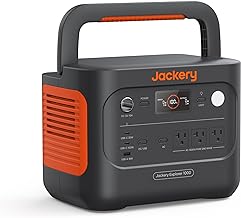
The Jackery 1000 Pro packs 1,024 Wh into a familiar, suitcase-like design. Its 2,000W continuous output easily covers fridge startup, and owner reviews consistently report 6–10 hours of fridge runtime. It’s lightweight (22 lbs), has a clean interface, and requires zero installation. The wall-outlet recharge time is about 1.6 hours. If you move frequently or want a no-commitment backup solution, this is a reliable choice.
Best for Whole-Home Integration
Bluetti AC500 + B300S — As of May 2026, per battery module
The AC500 is a modular hub (no battery included) that accepts up to four B300S batteries (each 3,072 Wh). A single B300S gives you 3,072 Wh with 5,000W continuous output—enough to run a fridge indefinitely (or until the battery depletes). Stack two or three batteries, and you can power multiple appliances for 24–48+ hours. Per manufacturer specs, the system is fully scalable and silent. It’s the most expensive option upfront, but it’s the most flexible if you think you’ll need whole-home backup in the future.
Maintenance and Long-Term Storage
Portable power stations degrade over time. Lithium-ion batteries (the standard in modern systems) typically retain 80–90% capacity after 5 years of regular use, per manufacturer datasheets from EcoFlow, Anker, and Bluetti. To maximize lifespan:
- Keep the battery between 20–80% charge for daily storage
- Avoid extreme heat (above 104°F / 40°C)
- Charge at least once every 3 months if stored long-term
- Keep the system in a cool, dry location
Most manufacturers warrant their batteries for 5–10 years or a set number of charge cycles (often 3,000–5,000 cycles). Check your specific model’s warranty before purchase.
Pairing Your Power Station with Solar (Optional)
If you expect outages to last longer than 24 hours, adding a solar panel array lets you recharge the battery during the day. A 400W portable solar panel can add 1–2 kWh per day in good sunlight, extending your fridge runtime indefinitely. See Best Portable Solar Panels for Camping: Reviews and Comparisons for panel options and How Solar Generators Work: Complete Beginner's Guide for a detailed explanation of how solar recharge works.
For most short-duration outages (under 12 hours), solar isn’t necessary. But if you live in an area with frequent multi-day outages, pairing a 3+ kWh battery with 400–600W of solar is a practical long-term strategy.
Generator Alternative: When a Battery Isn’t Enough
If you need unlimited runtime and don’t mind noise and fuel costs, a small inverter generator (2–4 kW) is an alternative. Per owner reviews and teardown analyses, inverter generators are fuel-efficient and produce cleaner power than traditional models, making them safer for refrigerator compressors.
However, generators require: - Regular maintenance (oil changes, spark plug checks) - Fuel storage (gasoline degrades over time) - Ventilation (exhaust is toxic—never run indoors) - Noise tolerance (60–80 dB, depending on model)
For apartment dwellers or those who want a silent, maintenance-free solution, a battery system is superior. See Portable Generator vs Whole-Home Generator: Cost and Setup for more detail on generator options and cost comparisons.
FAQ
What’s the best way to test a portable power station before an outage? Charge the system fully, plug in your fridge, and time how long it runs. Note the ambient temperature, how often you open the fridge door, and the final battery percentage when the fridge stops. This real-world test reveals your actual runtime and helps you decide if you need a larger system or additional battery modules.
Do I need a transfer switch to use a portable power station? No. A portable power station connects directly to your fridge via a standard outlet—no transfer switch required. Transfer switches are only needed for whole-home generators to prevent backfeeding electricity into the grid (a safety hazard). Portable systems are inherently safe because they’re not connected to your home’s electrical panel.
Can I use a small power bank to back up my fridge? No. A typical phone power bank (10,000–20,000 mAh) stores only 37–74 Wh—enough for a few phone charges, not a fridge. You need a dedicated portable power station with at least 2,000 Wh and 1,500W output.
Will my fridge work with a modified sine wave inverter? Probably not reliably. Modern refrigerators have electronic compressor controls that require a pure sine wave inverter to function safely. Modified sine wave inverters can damage the compressor. Always choose a system with a pure sine wave inverter.
What’s the difference between Wh and mAh? Wh (watt-hours) measures total energy; mAh (milliamp-hours) measures charge at a specific voltage. For backup power, Wh is the relevant metric. A 5,000 mAh battery at 5V = 25 Wh; the same 5,000 mAh at 48V = 240 Wh. Always read the Wh rating.
Can I run my fridge and other appliances on the same power station? Yes, if the system has enough wattage and capacity. A 3,000+ Wh system with 3,000W output can run a fridge (700W) plus lights, a laptop, or a fan. But each additional appliance reduces fridge runtime proportionally.
Summary
A refrigerator during a power outage is a real food-safety risk. Keeping it cold requires a backup system with at least 2,000 Wh of capacity and 1,500W of continuous output. For most households, a mid-tier portable power station (2–5 kWh) strikes the right balance between cost, portability, and runtime. If you rent, a battery system is your best option. If you own and want whole-home coverage, consider a modular system like the Bluetti AC500 or explore permanent generator installation.
Calculate your fridge’s actual wattage and duty cycle, size your battery accordingly, and test the system before an outage hits. A backup power plan is only useful if you’ve validated it works—don’t wait until the grid fails to discover your setup is undersized.
For more on choosing the right system for your home, see Best Battery Backup for Home Power Outages in 2026, How to Choose a Backup Power Station for Apartments, and Emergency Preparedness Checklist for Households and Apartments.


