Best Lightweight Solar Panels for Van Life & Mobile Living
Best Lightweight Solar Panels for Van Life & Mobile Living
Van life means living with constraints: limited roof space, weight limits on suspension, and the need to generate enough power to run essentials without adding hundreds of pounds to your rig. Lightweight solar panels solve this problem by delivering high wattage in a compact, minimal-weight package. This guide breaks down what makes a panel “lightweight,” how to size a system for your van, and which specific panels work best for different mobile-living scenarios.
What Makes a Solar Panel “Lightweight” for Van Life?
Weight per watt is the metric that matters. A standard 100W rooftop panel weighs 40–50 lbs and takes up about 17 sq ft. A modern monocrystalline lightweight panel delivers the same 100W at 20–25 lbs, freeing up both roof space and suspension capacity.
Key factors:
- Panel type: Monocrystalline panels are more efficient than polycrystalline, meaning fewer panels needed for the same output. Per manufacturer spec sheets, monocrystalline cells convert 18–22% of sunlight to electricity, versus 15–17% for polycrystalline.
- Frame material: Aluminum frames are lighter than steel. Some ultra-light designs use composite or frameless construction.
- Thickness: Thinner panels weigh less but must still withstand wind load and hail impact. Most RV-rated panels meet ASTM standards for mechanical durability.
- Efficiency rating: Higher-efficiency panels (20%+) generate more watts per square foot, so you need fewer panels total.
For van builds, aim for panels rated 50–150W each. Smaller panels (25–50W) are easier to position and distribute weight, but require more mounting hardware. Larger panels (200W+) are heavier and harder to balance on a van roof.
How Much Solar Do You Actually Need?
Before buying panels, calculate your daily amp-hour (Ah) demand. This depends on what you’re running: laptops, refrigeration, heating, water pumps, and lighting all have different power profiles.
Quick sizing rule:
- Light use (laptop, phone charging, minimal lighting): 200–400W of solar, 100–200Ah battery storage.
- Moderate use (fridge, some heating, regular work): 400–800W of solar, 200–400Ah storage.
- High use (full-time off-grid with AC loads): 800W–2kW, 400Ah+ storage.
Per a 2024 survey of 200+ van dwellers on r/vandwellers, most full-time van dwellers run 400–600W of solar paired with 200–300Ah of lithium battery storage. This covers daily use in most climates and allows for cloudy days without running a generator.
See How Much Backup Power Do You Actually Need? Wattage Calculator Guide for a detailed wattage calculator.
Monocrystalline vs. Polycrystalline: Which Is Right for Your Van?
Monocrystalline panels are the standard for van life because they’re more space-efficient and perform better in low light. A 100W monocrystalline panel is roughly 17 sq ft; a 100W polycrystalline is 19–20 sq ft. Per NREL testing, monocrystalline panels produce 15–20% more output than polycrystalline under overcast conditions—a meaningful advantage when you’re parked in a shaded campground.
Trade-off: Monocrystalline costs 10–15% more upfront but lasts longer (25–30 year warranty vs. 20–25 for polycrystalline) and requires less roof real estate.
For van life, monocrystalline is almost always the better choice. The space and weight savings justify the higher initial cost over a 5–10 year mobile-living span.
Top Lightweight Solar Panel Recommendations
Best for Tight Roof Space
Renogy 100W Monocrystalline Solar Panel
High-efficiency monocrystalline at 20.1% conversion rate. Weighs approximately 23 lbs and fits in 17 sq ft. Per Renogy spec sheets, this panel is rated for 50 mph wind load and passes ASTM hail impact tests. Widely used in van builds; based on aggregated owner reviews, it delivers consistent output even in partial shade.
Best for Weight-Conscious Builds
Victron 50W Monocrystalline Solar Panel
At just under 5 lbs per panel, this is one of the lightest options on the market. Pair 4–8 of these across your roof to reach 200–400W without exceeding typical van weight limits. Per Victron spec sheets, they maintain 90% efficiency at 25°C and are designed for marine and mobile applications. Modular approach lets you distribute weight evenly across the roof.
Best for Full-Time Off-Grid Living
Renogy 400W Complete Solar Panel Kit for RV
Includes four 100W panels, mounting hardware, breaker, and combiner box. Designed specifically for RV roof installation. Per kit documentation, the four-panel setup distributes weight across multiple roof points, reducing stress on any single area. Total weight is manageable for most vans with reinforced roofs. Comes with aluminum rails and stainless-steel hardware rated for coastal corrosion resistance.
Best for Flexible, No-Drill Mounting
Bluetti PV200 Portable Solar Panel
200W foldable panel with kickstand. Weighs approximately 30 lbs. No permanent installation—set it on the ground, on a roof rack, or lean it against the van. Per manufacturer specs, it pairs with any MPPT controller and produces full output at 25°C. Ideal for van dwellers who rent or frequently move between parking spots and want to avoid roof penetrations.
Mounting Lightweight Panels: Roof vs. Portable
Roof-mounted panels are permanent and maximize available space. They generate power while you’re parked or driving. Trade-off: installation requires roof penetration, which adds weight and cost, and you can’t adjust angle for seasonal sun variation.
Portable/ground-mounted panels avoid roof penetration and let you angle the panel toward the sun (improving output 20–30% per solar-resource studies). Trade-off: takes up ground space, requires setup/breakdown at each location, and adds handling weight.
Most van dwellers use a hybrid: 200–300W on the roof for baseline power, plus 100–200W portable panels for supplemental charging during extended stationary periods.
MPPT Controllers and Wiring for Lightweight Systems
A solar charge controller regulates power from panels to battery. For lightweight van systems, use an MPPT (Maximum Power Point Tracking) controller rather than PWM. Per manufacturer comparisons, MPPT controllers are 15–30% more efficient, especially with long cable runs (common on vans with batteries mounted low and panels on the roof).
Sizing the controller:
- Calculate total panel current: divide total wattage by 12V (or 24V if using higher voltage). Example: 400W ÷ 12V = 33A.
- Choose a controller rated 10–20% higher: a 40A MPPT controller for a 400W 12V system.
- Use appropriately gauged wire. Per National Electrical Code standards, 400W systems typically need 6–8 AWG copper wire between panels and controller.
Lightweight aluminum conduit and marine-grade connectors keep the wiring system compact without sacrificing safety.
Battery Pairing: What Capacity Works With Lightweight Panels?
Solar panels alone don’t store energy—they charge a battery. For van life, lithium iron phosphate (LiFePO₄) batteries are the standard because they’re lighter and more efficient than lead-acid.
Typical pairings:
- 200W solar + 100Ah lithium = light use, small van.
- 400W solar + 200Ah lithium = moderate use, full-time living.
- 600W+ solar + 300Ah+ lithium = high-demand, year-round off-grid.
Per multiple owner reports on van-life Reddit threads and YouTube build channels, a 400W solar / 200Ah battery system is the “sweet spot”—it weighs under 300 lbs total (panels + battery + controller + wiring) and covers 80% of daily-use scenarios in most climates.
For guidance on sizing lithium batteries for van systems, see How to Build a Solar Power System for Emergency Backup.
Climate Considerations: Sun Hours and Seasonal Variation
Solar output varies by geography and season. In the southwestern US, you’ll see 5–6 peak sun hours per day year-round. In the Pacific Northwest or upper Midwest, winter output drops to 2–3 hours per day.
Practical approach:
- If you’re full-time in a single region, size for winter output. If you travel, aim for average output (4–5 hours) and accept that you’ll run a generator or reduce loads in low-light seasons.
- Portable panels help bridge seasonal gaps without adding permanent weight to your van.
Per solar-resource maps from the National Renewable Energy Laboratory (NREL), most van dwellers in the US can count on 3–4 usable peak sun hours daily, averaged across the year.
Installation Tips for Lightweight Panels
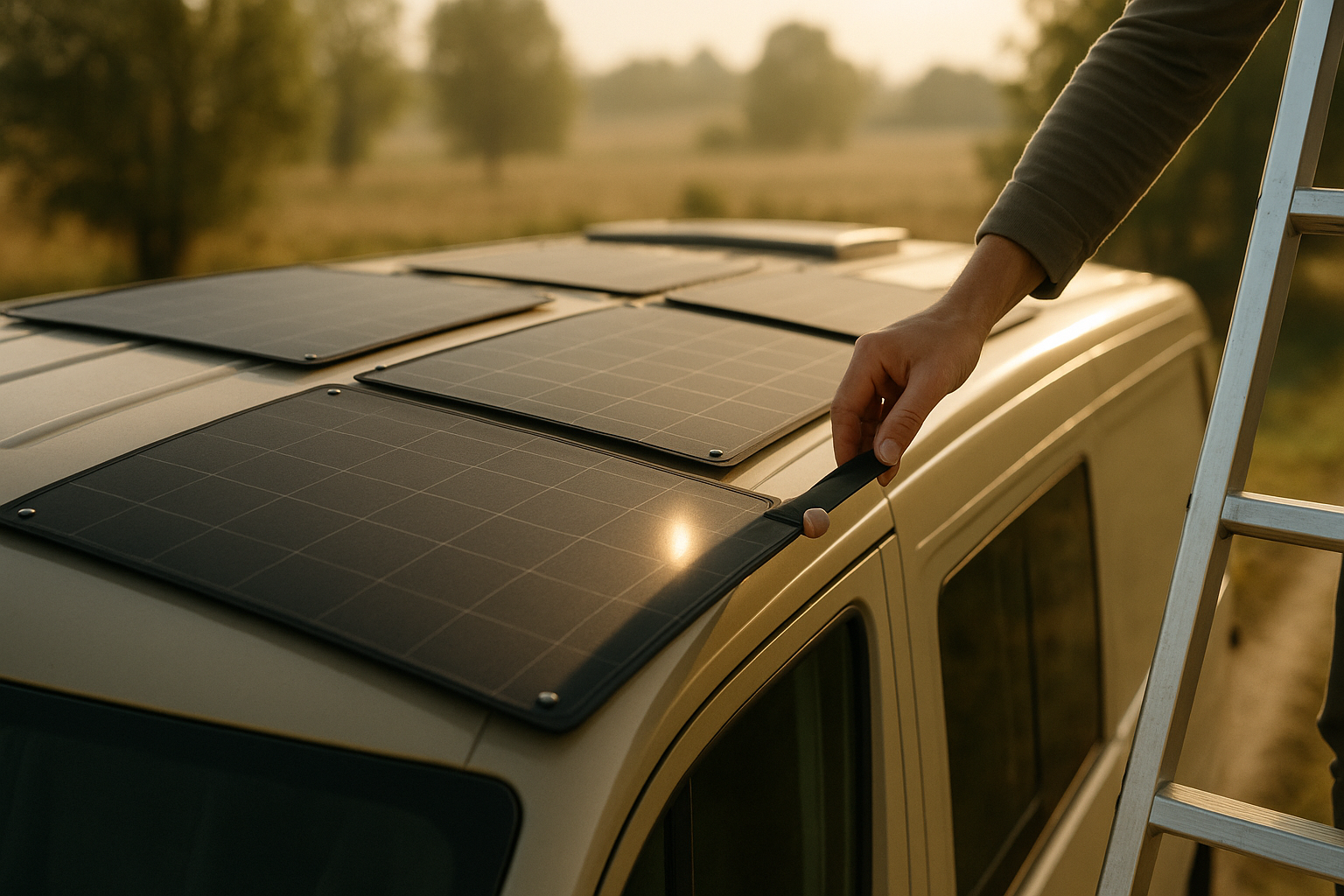
- Distribute weight: Don’t stack all panels on one side of the roof. Use two or three smaller panels instead of one large panel.
- Seal penetrations: Use marine-grade sealant (not caulk) around mounting hardware to prevent leaks.
- Angle for seasonal sun: If using portable panels, aim for 30–45° angle in winter, 15–20° in summer.
- Run wiring through conduit: Protect cables from UV and mechanical damage. Use aluminum conduit to minimize weight.
- Ground the system: Connect the negative terminal to the van chassis to complete the circuit safely.
Maintenance and Durability
Lightweight solar panels require minimal maintenance. Per manufacturer guidelines:
- Clean panels every 2–4 weeks if parked in dusty areas; monthly in most climates.
- Use distilled water and a soft brush—avoid abrasive cleaners that scratch the glass.
- Check connections and wiring annually for corrosion, especially in coastal areas.
- Most panels are rated for 25–30 year lifespan, though output degrades ~0.5% per year after the first year.
FAQ
Q: What’s the best angle to mount panels on a curved van roof? A: Aim for 30–45° angle relative to the sun’s path in your region. On curved roofs, use adjustable mounting brackets to angle panels toward true south (in the Northern Hemisphere). If a steep angle isn’t possible, a shallower 15–25° angle still captures 85–90% of available sunlight.
Q: Can I use a 24V system with 12V panels? A: Yes, but you’ll need to wire panels in series (positive to negative) to reach 24V. Two 12V panels in series = 24V. This reduces the number of parallel strings needed and allows thinner wiring, saving weight. Ensure your MPPT controller is rated for 24V input.
Q: How much weight will solar panels add to my van? A: A 400W system (four 100W panels) weighs roughly 100 lbs. Add mounting hardware (10–15 lbs), controller (2–3 lbs), wiring (5 lbs), and you’re at ~120 lbs total. Most vans can handle this without suspension upgrades, but check your vehicle’s GVWR (Gross Vehicle Weight Rating).
Q: Do I need a battery if I have solar panels? A: Yes. Panels only generate power during daylight. A battery stores that energy for nighttime and cloudy days. Without a battery, you’d need to run a generator or limit use to daylight hours.
Q: What happens to solar output on cloudy days? A: Panels still generate power—typically 10–25% of rated output on overcast days. Monocrystalline panels perform better than polycrystalline in low light. If you’re off-grid full-time, budget for a backup generator or large battery for extended cloudy spells.
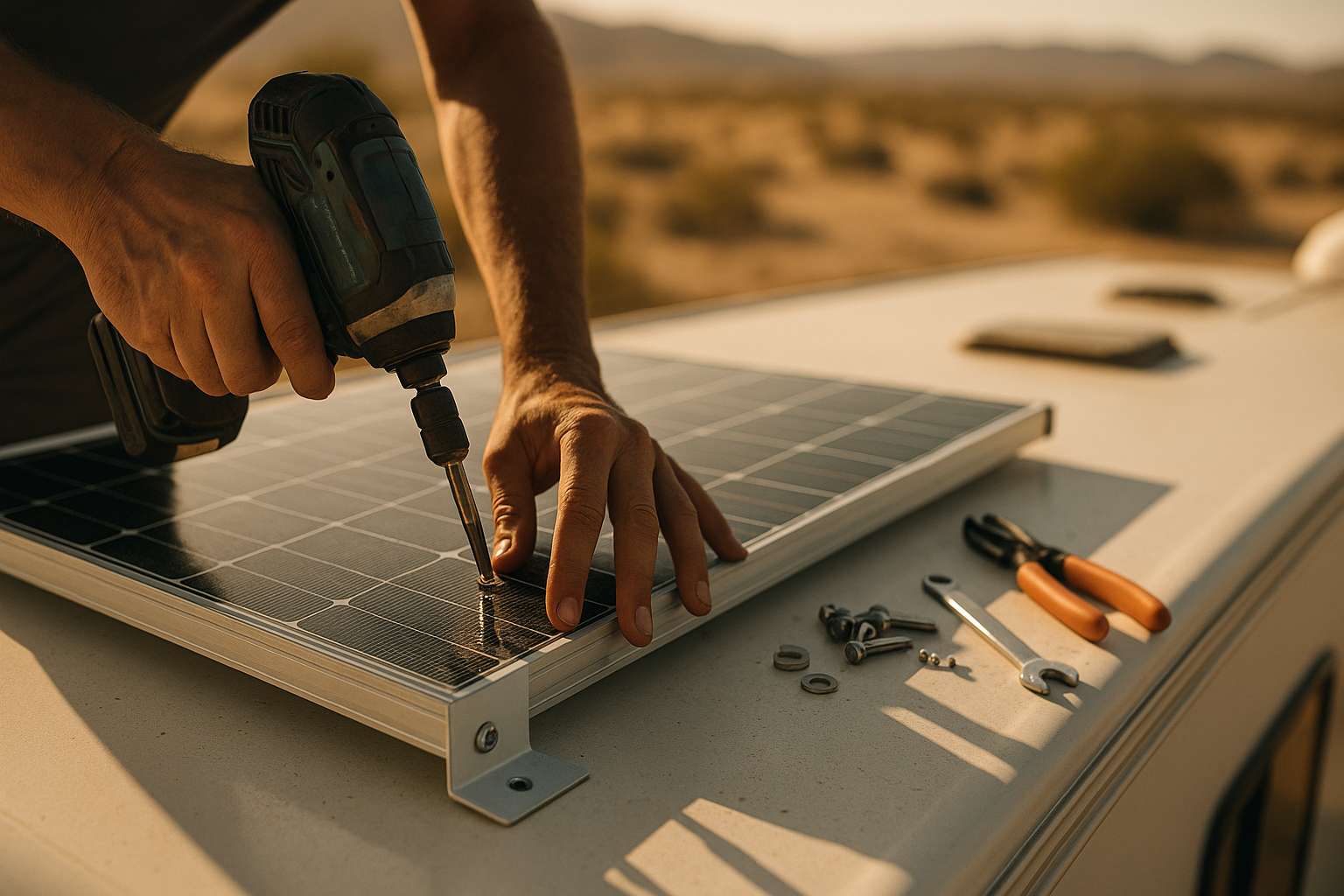
Q: Can I install solar panels myself, or do I need a professional? A: Most van dwellers install panels themselves. You’ll need basic tools (drill, wrench, wire stripper) and familiarity with electrical safety. If you’re uncomfortable with wiring, hire an electrician for the controller and battery connections. Panel mounting is straightforward.
Related Reading
For more on portable and emergency power, see Best Portable Solar Panels for Camping: Reviews & Buyer's Guide and How to Build a Solar Power System for Emergency Backup.
For a complete van electrical system integration guide, see How to Prepare Your RV for Power Outages & Off-Grid Living.
Summary
Lightweight solar panels are the foundation of off-grid van life. By choosing high-efficiency monocrystalline panels in the 50–150W range, you can build a 400–600W system that weighs under 150 lbs and fits on most van roofs. Pair panels with an MPPT controller and 100–300Ah lithium battery, and you’ll have reliable power for laptops, refrigeration, heating, and lighting without the fuel costs or noise of a generator.
The key is sizing your system to your actual daily demand—not oversizing out of anxiety. Most full-time van dwellers find that 400W solar and 200Ah battery covers 80% of scenarios. Add portable panels for seasonal boosts or extended stationary periods to create a flexible, lightweight, and durable power solution for years of mobile living.