Lightweight Emergency Gear for Van Life in 2026
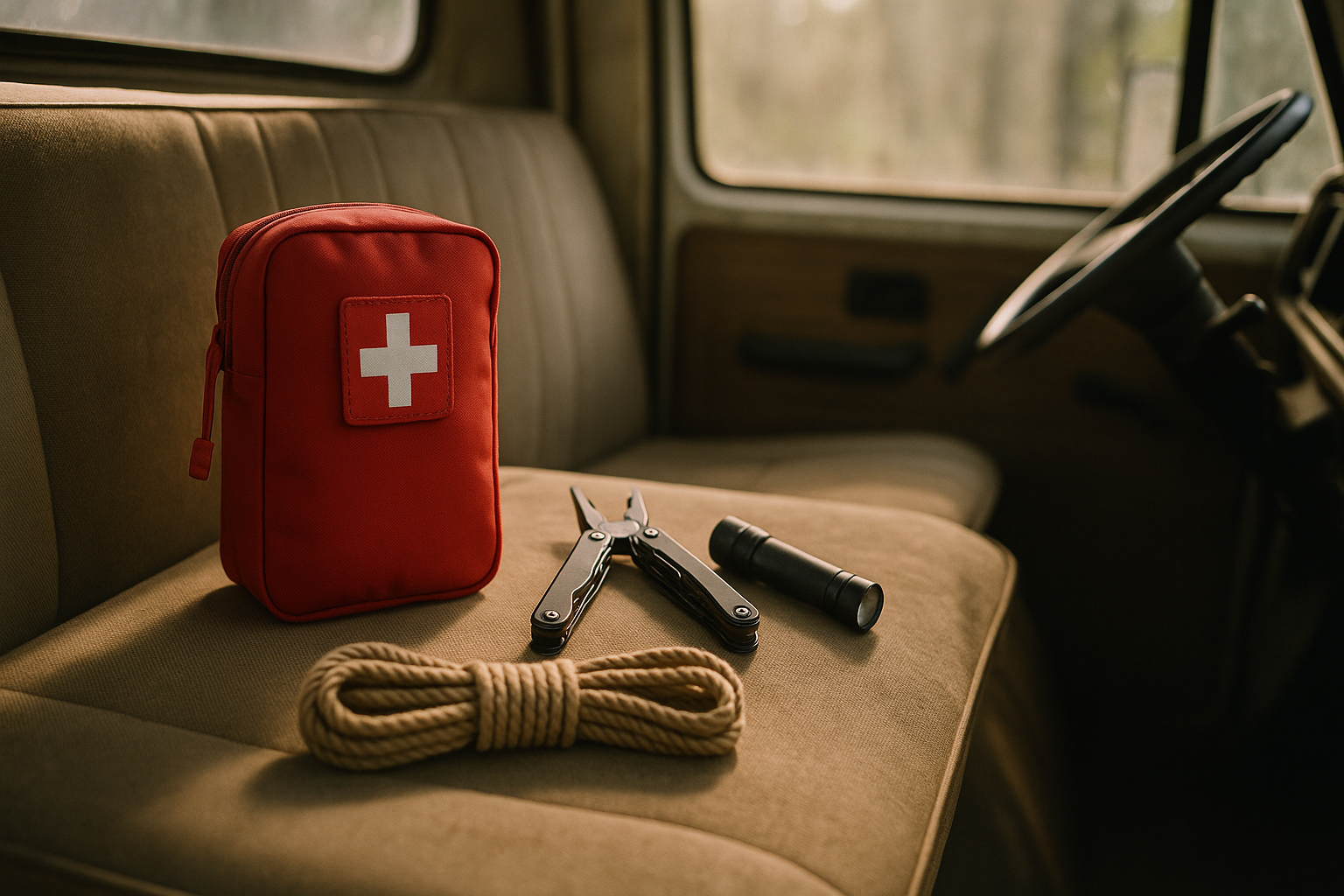
Lightweight Emergency Gear for Van Life: Compact Power & Survival Kit
Van life means living small. When an emergency hits—mechanical failure, sudden weather, medical issue, or power loss—your gear has to earn every inch of storage space. This guide covers the essentials that actually fit in a van and keep you safe without forcing you to choose between a spare tire and a first-aid kit.
Why Van Life Emergency Prep Is Different
Living in a vehicle means you’re your own first responder. You can’t call a neighbor to borrow tools, run to the pharmacy, or plug into a wall outlet. Space is ruthless: every item must justify its footprint. Weight matters too—overloading a van affects fuel economy, handling, and your ability to move quickly if conditions deteriorate.
The gear in this guide prioritizes redundancy in compact form. That means a power bank that fits in a glove compartment, a water filter you can carry in one hand, and a first-aid kit organized by frequency of use, not completeness.
Power: The Single Most Critical System
A dead battery in a van isn’t just inconvenient—it can be dangerous. You lose heat, cooling, navigation, communication, and the ability to run medical devices. Portable power stations and solar panels are the van-lifer’s insurance policy.
Portable Power Stations (Battery Capacity Matters)
A mid-tier portable power station (300–600Wh) covers most van emergencies: - Phone charging (10–15 full cycles) - Laptop work (4–6 hours) - Small fridge or cooler (4–8 hours, depending on ambient temp) - LED lighting and fan operation (12+ hours) - Medical devices (CPAP, insulin cooler, nebulizer)
Per manufacturer specs and aggregated owner reports across van-life forums, units in the 300–500Wh range weigh 6–10 lbs and fit under a bench seat or in a cabinet. For example, the Jackery Explorer 240 weighs 6.6 lbs vs. the EcoFlow River 2 Pro at 7.7 lbs—a meaningful difference in tight spaces. Larger units (1000Wh+) are heavier but necessary if you’re running a small inverter for tools or a portable heater.
Key spec to check: AC output wattage (not just Wh). A 300Wh station with a 300W inverter can’t run a 400W device, even briefly. Look for at least 500W continuous output if you plan to use power tools or heating.
Concrete scenario: If you run a 12V portable fridge (40W) for 8 hours daily, you need approximately 320Wh minimum capacity. A 300Wh station covers this with minimal margin; a 500Wh station provides comfortable buffer for other devices.
Solar Panels: Silent, Infinite Backup
Portable solar panels are the force multiplier. Per manufacturer testing, a 100W panel adds roughly 400–500Wh per sunny day to a power station. For van dwellers, this means: - Never fully depleting your battery bank - Extending trips without relying on campground hookups - Charging during the day while you work or explore
Flexible panels (100–200W) weigh less and mount on curved van roofs; rigid panels are more efficient in tight spaces. Per aggregated owner reports, flexible panels lose 2–3% efficiency compared to rigid equivalents, but the weight savings and easy installation often justify the trade-off for van life.
Best Solar Panels for Van Conversion: Flexible & Rigid Options
Best Portable Solar Panels for Camping in 2026
Water: Filtration Over Storage
Carrying large water tanks eats space fast. Instead, prioritize a compact filter system that lets you refill safely from almost any source—creeks, campground spigots, even questionable tap water in remote areas.
Gravity filters (like the LifeStraw family) weigh 5–8 oz and don’t require electricity. Per manufacturer specs, most remove bacteria, protozoa, and some viruses; they’re rated for 1000–5000 liters before replacement. They’re slow (15–30 min per liter) but reliable.
Squeeze filters are faster (2–3 minutes per liter) and lighter, but require more arm strength. Ideal for day trips or topping off a 2–3 gallon emergency jug.
Boiling is the backup: a small camping stove or even a car kettle (12V) can pasteurize water in minutes. Keep a lightweight stainless-steel pot (under 1 lb) and a camp stove in your emergency kit.
Store at least 1 gallon of drinking water year-round (more in hot climates). Rotate it every 6 months. Add electrolyte packets or coconut water powder to prevent hyponatremia if you’re sweating heavily.
First Aid & Medical: Organized by Use Frequency
A bloated first-aid kit is useless—you won’t maintain it, and you’ll waste space. Instead, organize by what you’ll actually use:
Tier 1 (daily/weekly): antihistamine, pain reliever, antacid, anti-diarrheal, blister treatment, adhesive bandages, antibiotic ointment. Keep this in a small ziplock in your glove box.
Tier 2 (monthly/occasional): elastic bandage, tweezers, scissors, gauze pads, medical tape, hydrocortisone cream, antihistamine cream, instant cold pack. Store in a 6×4×2-inch plastic box under a seat.
Tier 3 (emergency only): tourniquet, Israeli bandage, triangular bandage, CPR face shield, emergency blanket, pain relief injection (if prescribed), prescription medications in duplicate. Keep this sealed and labeled in your main emergency bag.
If you take regular medications, carry a 30-day supply plus a photocopy of your prescription. Store medications in a cool, dry place (not the dashboard—heat degrades them fast).
Per long-running threads on r/vandwellers and r/overlanding, the most-used items are blister treatment, pain relievers, and anti-diarrheal meds. Don’t skip those for exotic supplies you’ll never need.
Communication & Navigation
A dead phone is a dead link to help. Carry:
- Portable charger (20,000mAh+): fits a jacket pocket, charges most phones 4–5 times. Redundancy is key—carry two if you rely on your phone for navigation or emergency calls.
- Offline maps: download your region (and adjacent states) to your phone via Google Maps, AllTrails, or Gaia GPS. These work without cell signal.
- Backup navigation: a paper map and compass. Sounds old-school, but it works when your phone dies and you’re in a dead zone. Cost is negligible, weight is under 4 oz.
- Communication backup: a personal locator beacon (PLB) or satellite communicator (like Garmin inReach) if you frequent remote areas. These are premium-tier but literal lifesavers in areas with zero cell coverage.
Tools: Minimal, Multi-Purpose
A full toolbox doesn’t fit in a van. Instead, carry a compact multi-tool (Leatherman or equivalent), a small adjustable wrench, a flashlight with extra batteries, jumper cables, and a tire plug kit. Per owner reports from van-life forums and mechanic surveys, these five items cover most common roadside emergencies.
Add a small fire extinguisher (2–5 lb, ABC-rated) mounted near the driver’s seat. Fires in confined spaces escalate fast; a 30-second extinguisher can mean the difference between a controlled situation and total loss.
Emergency Documents & Cash
Keep originals or certified copies of: - Vehicle registration and insurance - Driver’s license and passport - Medical records and medication list - Emergency contact info - Proof of roadside assistance membership (AAA, etc.)
Store these in a waterproof pouch. Add 200–500 dollars in cash (small bills) in a separate location. If your card reader fails or cell service drops, cash is your only option.
Clothing & Shelter
A breakdown in winter or a sudden storm requires shelter fast. Keep in your van year-round: - One warm layer (fleece or down jacket) - One rain jacket - Sturdy shoes (not flip-flops) - An emergency blanket (space-age reflective, weighs 2 oz, packs to 4×2 inches) - A tarp or emergency bivy (10×10 ft tarp weighs 8 oz and can create shelter, windbreak, or ground cover)
Per owner reports from r/vandwellers and r/overlanding, the difference between “uncomfortable” and “hypothermia risk” is often a single layer you actually have with you.
Seasonal Adjustments
Summer: prioritize water (extra filters, electrolyte packets), sunscreen, insect repellent, and cooling (battery fan, wet cloth, shade tarps).
Winter: add extra blankets, hand warmers, a small propane heater (properly vented), and engine block heater if you’re in snow country. Per battery manufacturer testing, cold reduces effective capacity by 20–30%, so keep battery capacity higher than summer estimates.
Spring/Fall: focus on water filtration and tool redundancy. Mud season and temperature swings create the most breakdowns.
Maintenance: Keep Your Gear Ready
Check your emergency kit every 6 months: - Rotate water and food - Test the power station (charge it fully, drain it halfway, recharge) - Replace expired medications - Check battery expiration dates - Inspect solar panel connections for corrosion
Per owner reports, a neglected emergency kit is worse than no kit—dead batteries and expired meds create false confidence.
FAQ
Q: Can I rely solely on my car’s battery for emergencies? A: No. Your car battery powers the engine, lights, and ignition. Drawing it down for other uses risks being stranded. A dedicated portable power station is essential.
Q: What’s the difference between Wh and Ah? A: Wh (watt-hours) measures total energy; Ah (amp-hours) measures charge capacity. A 100Ah battery at 12V = 1200Wh. For van life, focus on Wh—it directly tells you how long devices will run. A 300Wh station runs a 100W device for 3 hours (before inefficiency losses).
Q: Can I use a car inverter instead of a power station? A: A car inverter (12V DC to 120V AC) runs off your vehicle battery, which drains your starting power. It works for brief use (charging a laptop, running a tool for 10 minutes) but isn’t reliable for emergencies. A dedicated power station with solar backup is safer and more practical.
Q: How often should I replace my water filter? A: Per manufacturer guidance, most gravity and squeeze filters last 1000–5000 liters. For a solo van dweller using 1–2 gallons daily, that’s 1–5 years. Check the filter’s instruction manual and replace when flow slows noticeably.
Q: Do I need a satellite communicator if I have a phone? A: Only if you frequently travel in areas with zero cell coverage (deep backcountry, remote desert, mountains). For van life on established roads and campgrounds, a phone plus offline maps is usually sufficient. A PLB or inReach is insurance for true off-grid exploration.
Building Your Kit: Start Small, Iterate
You don’t need everything at once. Start with: 1. A portable power station (300–500Wh) 2. A water filter 3. A basic first-aid kit 4. A multi-tool and flashlight 5. Offline maps and a paper map
Use your van for 2–3 months. Identify what you actually need (versus what you thought you’d need). Then add solar panels, redundant power banks, or advanced communication tools based on real experience.
The best emergency kit is the one you maintain and trust. Lightweight, compact gear that fits your van and your lifestyle beats a comprehensive kit gathering dust in a closet.


