Backup Power for Refrigerator During Outage: 2026 Guide

Photo by Zendure Power Station on Unsplash
Backup Power Supply for a Refrigerator During an Outage
When the grid drops, the refrigerator is usually the first appliance people worry about — and rightly so. Per the FDA’s food safety during power outage guidance, a refrigerator holds food safely for about 4 hours with the door shut, and a full freezer holds for roughly 48 hours (24 hours if half-full). After that you’re looking at spoiled food and a freezer full of half-thawed meat. The right backup power supply buys you enough runtime to ride out the outage or at least save the contents.
This guide covers what size battery or generator you actually need, how to estimate runtime honestly, and which option fits which living situation.
How much power does a refrigerator really draw?
This is where most sizing advice goes wrong. A modern Energy Star fridge does not pull its nameplate wattage continuously. It cycles.
Per manufacturer spec sheets for common 18–22 cu. ft. models (e.g., Whirlpool WRT318FZDW top-freezer, LG LRFXS2503S french-door, GE GNE25JSKSS side-by-side):
- Running wattage: typically 100–250W while the compressor is on
- Starting (surge) wattage: roughly 600–1,200W for a fraction of a second when the compressor kicks in
- Duty cycle: the compressor runs maybe 30–50% of the time in a normal kitchen, less if you keep the doors shut during an outage
- Daily energy use: 1–2 kWh per day for newer units, 2–4 kWh for older or larger ones (check the yellow EnergyGuide sticker on your fridge — that’s the real number for your unit)
Two takeaways. First, the surge matters more than the running watts when picking a power source — an inverter that can’t handle the compressor start will trip offline. Second, “watts” alone won’t tell you runtime. You need watt-hours (Wh) on the battery side or fuel capacity on the generator side.
The four real options
There are essentially four ways to keep a fridge cold when the grid is down. Each has a different cost, noise, and runtime profile.
1. Portable power station (lithium battery + inverter)
A sealed box with a lithium battery, a pure sine wave inverter, and AC outlets. Silent, safe indoors, no fumes. This is what most apartment dwellers and suburban homeowners end up buying in 2026 because LiFePO4 prices have come down enough to make it sensible.
- Best for: outages of 6–24 hours, apartments, anyone who can’t run a generator outside
- Watch for: continuous inverter rating (need at least 600W, ideally 1,000W+ to handle compressor surge), and total Wh capacity (1,000Wh = roughly 8–12 hours of fridge runtime; 2,000Wh = a full day or more)
- Limitation: once the battery is empty, it’s empty — unless you can recharge from solar or a running car
If you’re deciding between specific capacities and want to plug your own fridge’s daily kWh figure into the math before buying, Portable Power Station for Refrigerator: Runtime & Sizing Guide walks through the watt-hour calculation with worked examples.
2. Inverter generator (gasoline or propane)
A small 1,000–2,500W inverter generator will run a fridge indefinitely as long as you have fuel. Modern inverter models are dramatically quieter than the old open-frame contractor generators — per owner reports across r/preppers and r/generator, the well-known Honda and Yamaha units sit around conversation-level noise at 25 feet.
- Best for: multi-day outages, houses with outdoor space, rural areas with frequent storms
- Watch for: must be run outside, away from windows — carbon monoxide kills people every storm season. Per CPSC data, generator-related CO deaths spike during widespread outages.
- Limitation: noise, fuel storage, maintenance, can’t be used in apartments or attached garages
See Best Quiet Generator for Home Backup Under $1000 for specific quiet-generator picks that handle fridge loads.
3. Solar generator (power station + panel)
A portable power station bundled with one or more solar panels. Functionally the same as option 1 but with recharge capability during daylight. For outages longer than a day where you have sun exposure, this is the most practical “set it and forget it” option for apartment dwellers.
Realistic recharge times are slower than the marketing suggests — see Solar Generator Charging Time: How Fast Do They Really Recharge? for what to actually expect.
4. Home battery system (whole-home or partial)
Wall-mounted LiFePO4 systems in the 2–10 kWh range that integrate with your home panel via a transfer switch or critical-loads subpanel. Expensive, requires installation, but runs the whole kitchen plus lights for a day or more on a single charge.
- Best for: homeowners in storm-prone areas willing to invest in permanent infrastructure
- Limitation: install cost, permitting, not portable
Best Home Battery Backup Systems Under $2000 for 2026 covers the entry-level end of this category.
Sizing: how long will it actually run?
Here’s the honest math for a 150W-average refrigerator with the door kept closed during an outage. The 150W figure is based on aggregated owner-reported draw data from long-running threads on r/powerstations and the Hobotech and Will Prowse channel test logs, which consistently show 130–170W average pull for 18–22 cu. ft. units with the doors shut.
| Battery capacity | Realistic fridge runtime |
|---|---|
| 500 Wh | 3–4 hours |
| 1,000 Wh | 7–10 hours |
| 1,500 Wh | 10–15 hours |
| 2,000 Wh | 14–20 hours |
| 3,000 Wh | 20–30 hours |
These figures already account for inverter overhead of roughly 10–15% of nameplate Wh. That loss number comes from Will Prowse’s bench tests on the EcoFlow Delta 2, Bluetti AC180, and Anker SOLIX C1000, where measured AC throughput consistently landed 86–90% of rated battery capacity under a steady 150W resistive load. Manufacturers rarely advertise the loss, but it’s reproducible.
If you have a chest freezer too, double the average wattage and halve the runtime estimate. Chest freezers cycle less but draw harder when they do.
What about UPS units?
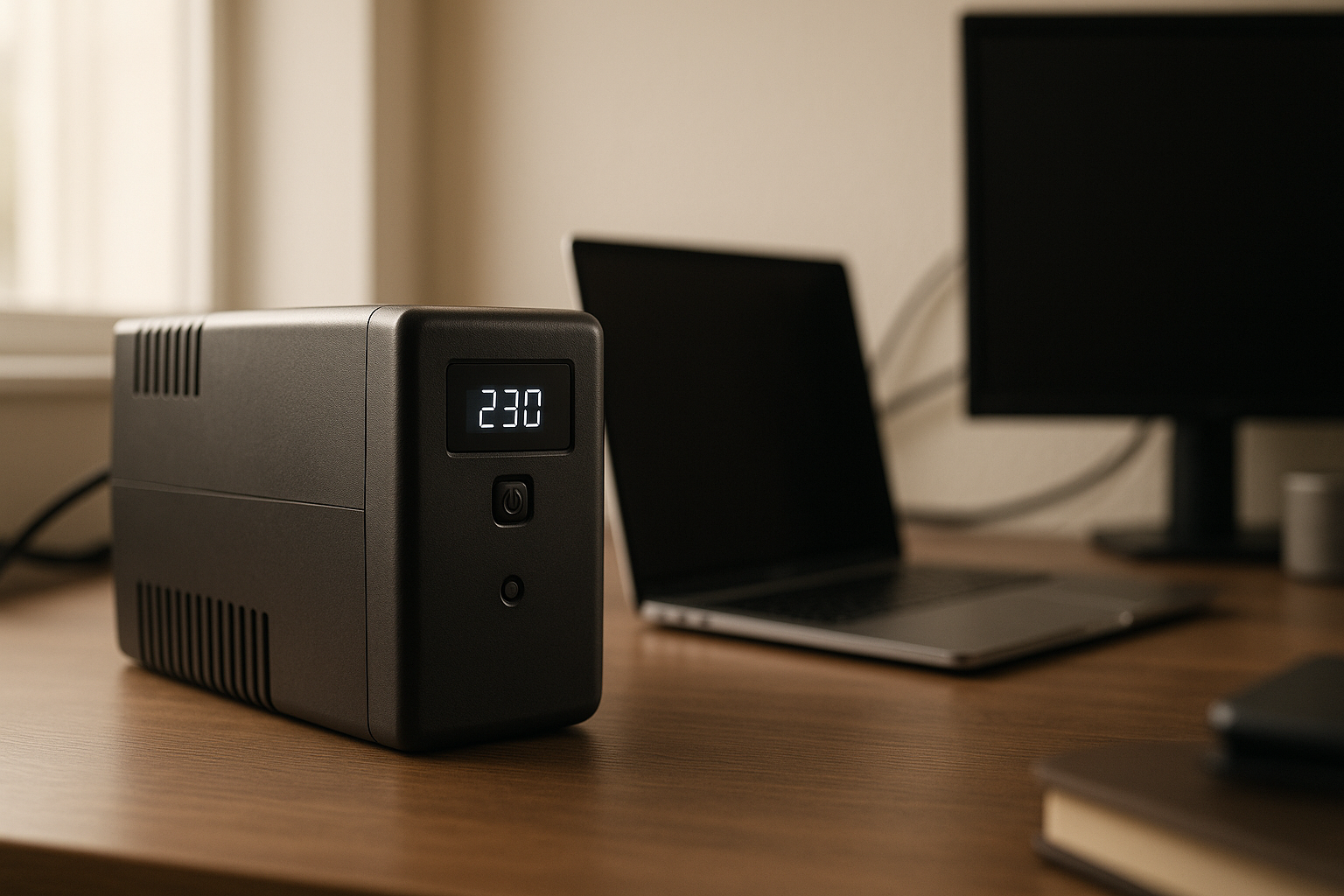
A UPS (uninterruptible power supply) is designed for short bridges of power — keeping a desktop computer alive long enough to save files and shut down cleanly. Standard consumer UPS units in the 600–1,500 VA range hold a fridge for maybe 5–15 minutes. They’re not a fridge solution.
Where a UPS does matter: keeping your modem, router, and home office gear alive during brief outages. For that, see Best Uninterruptible Power Supply for Home Office: UPS Buying Guide and Emergency Backup Power for Home Office: UPS vs Portable Station for the UPS-vs-power-station comparison.
What to look for in a power station for fridge duty
Four specs matter more than the rest:
-
Pure sine wave inverter, not modified sine. Refrigerator compressors are inductive loads and don’t tolerate dirty waveforms well. Modified-sine inverters can cause the compressor to run hot or fail to start. Most current mainstream power stations advertise pure sine output, but cheap no-name units on Amazon still ship with modified-sine inverters — verify on the spec sheet before buying.
-
Continuous output of at least 1,000W. You can technically get away with 600W if your fridge has a soft-start compressor, but 1,000W+ gives you headroom for the surge and lets you plug in a second appliance.
-
LiFePO4 chemistry, not NMC. LiFePO4 (lithium iron phosphate) cells last 3,000–4,000 cycles to 80% capacity, per manufacturer spec sheets — roughly 10x the cycle life of older NMC packs. Almost all 2026 power stations have switched to LiFePO4 for this reason.
-
UPS-mode or fast-switchover (sub-20ms). Some power stations can act as a pass-through and switch to battery within 10–20 milliseconds of grid loss. This matters if you want truly seamless backup for the fridge without anyone reaching for a plug.
For broader option comparisons that include propane and dual-fuel approaches, Backup Power Supply for Refrigerator During Power Outage: Options Explained goes deeper.
Apartment vs. house: different answers
Apartments. You can’t run a gas generator on a balcony — fire codes prohibit it in most jurisdictions, and CO is a real risk. A power station is effectively your only option. A 1,500–2,000 Wh unit handles a fridge for most realistic outage windows. How to Choose a Backup Generator for Apartments (Quiet & Compact) covers the few edge cases (detached units with proper outdoor space) where small generators might work.
Houses. You have all four options. The pragmatic answer for most homeowners is a 2,000Wh+ power station for short outages plus a small inverter generator for anything beyond 24 hours. The generator recharges the power station, which runs the fridge silently overnight. This hybrid setup costs less than a whole-home battery and handles 90% of real-world outage scenarios.
Practical outage protocol
A backup power supply is only half the system. The other half is behavior. Per FEMA guidance and FDA food-safety rules:
- Don’t open the fridge unnecessarily. A closed fridge holds cold for about 4 hours, a closed freezer for 24–48 hours, with no power at all.
- Move perishables from fridge to freezer if the outage looks long. Cold mass helps the freezer stay cold longer.
- Plug in only the fridge. Unplug everything else — coffee makers, microwaves, anything with a standby load — to stretch battery runtime.
- Use the 40°F rule. If fridge contents stayed below 40°F, they’re safe. Above that for more than 2 hours, throw out meat, dairy, eggs, and leftovers. A cheap fridge thermometer makes this call easy.
- Recharge the power station from your car if needed. A 12V car outlet plus the included adapter trickles roughly 100W into the station — enough to extend runtime meaningfully if the outage drags on.
FAQ
What’s the difference between LiFePO4 and NMC batteries, and does it matter for fridge backup? LiFePO4 (lithium iron phosphate) cells last roughly 3,000–4,000 cycles to 80% capacity, tolerate heat better, and are far less prone to thermal runaway. NMC (nickel manganese cobalt) packs are lighter and more energy-dense per pound but typically rated for 500–800 cycles. For stationary fridge backup where weight doesn’t matter and you might cycle the pack hard during a multi-day outage, LiFePO4 is the clearly better chemistry. Most reputable 2026 power stations use it.
Can I just use a UPS instead of a power station? No — and this is a common mistake. A typical 1,500 VA consumer UPS holds maybe 600–900 Wh of usable energy and is tuned for high-wattage short-duration draws (a PC for 10 minutes), not the multi-hour low-draw cycling a fridge needs. You’ll get 15 minutes of fridge runtime at best, and many UPS units will refuse to start the compressor at all because the surge trips their overload protection. Use a power station with an explicit UPS pass-through mode if you want both functions.
Can a small generator damage my fridge? Yes, if it’s a non-inverter (open-frame) generator producing dirty power. The voltage swings can stress the compressor electronics over time. Inverter generators produce clean sine wave output equivalent to grid power and are safe for fridges — this is documented across appliance manufacturer guidance.
Will the fridge start on a 600W power station? Maybe. The continuous draw is fine, but the compressor surge can exceed 1,000W for a fraction of a second. Some 600W units have surge ratings of 1,200W and handle it; others trip offline. Check the surge spec, not just continuous output. Newer fridges with inverter compressors (variable-speed) have much lower sur